

At the peak of the Detroit Lions’ offensive success from 2022-24, the engine that drove the team’s identity was a proven, dependable, and imposing offensive line—arguably one of the most defining units in all of football.
Since then, that group has undergone significant turnover. Frank Ragnow retired, while Taylor Decker and Graham Glasgow were released amid contract differences and a desire to get younger and more sustainable. Jonah Jackson and Kevin Zeitler also departed in free agency at different times.
While there were other factors at play—including an underwhelming tenure from offensive coordinator John Morton—the Lions’ fall from first to worst in the division last season can largely be traced back to the offensive line’s regression. What was once a strength became a clear Achilles’ heel.
This offseason, the organization has made a concerted effort to reclaim its identity in the trenches, adding players like Cade Mays, Larry Borom, Ben Bartch, and Juice Scruggs to help restock the unit.
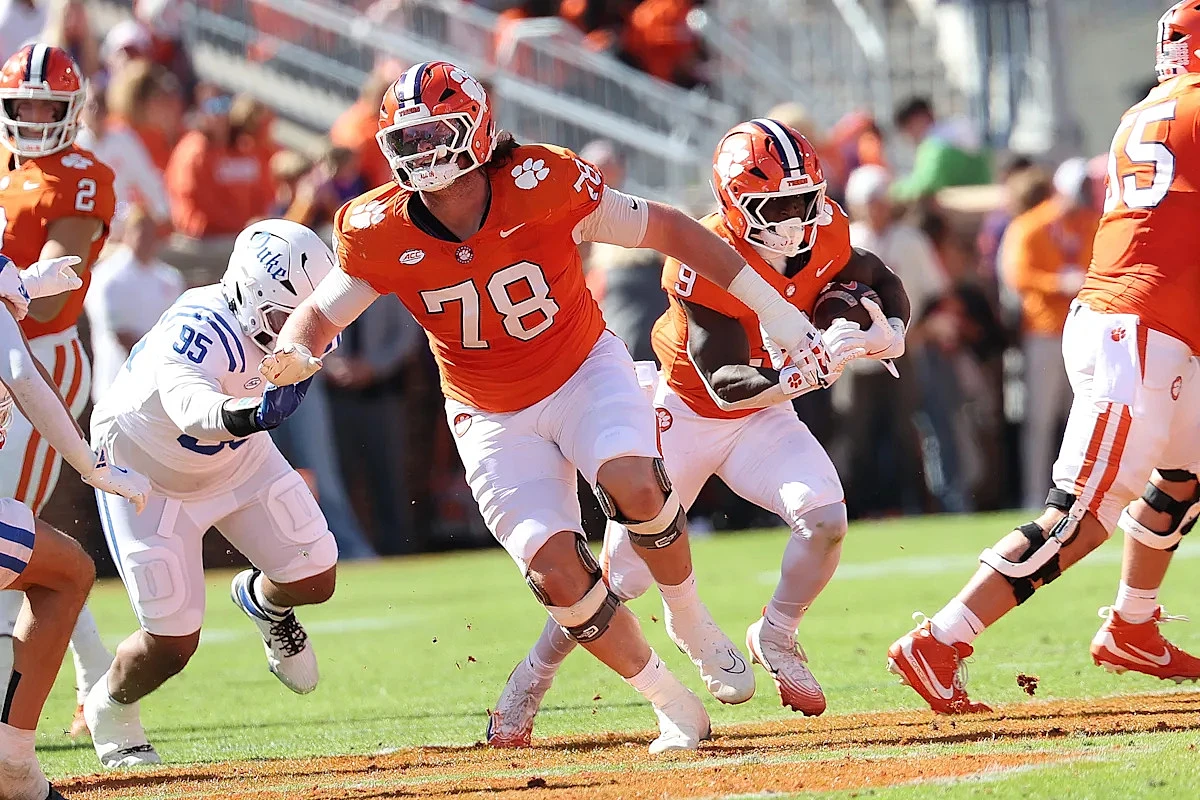
Given the premium nature of the offensive tackle position—and the strength of this draft class at the top—the Lions are well positioned to use a top-20 pick to put the finishing touches on their offensive line remodel. Blake Miller, Clemson’s right tackle, stands out as a strong candidate to be the best player available when Detroit is on the clock.
Blake Miller’s most underrated trait is his athleticism, which is often left out of the discussion when he’s labeled as a “safe” or “high-floor” prospect.
He checks in at over 6-foot-6 and 317 pounds, with an 83 7/8-inch wingspan and 34 1/4-inch arms—comfortably checking all of the boxes from a size and length standpoint.
The Midwest native (Strongsville, OH) also registered a 5.04-second 40-yard dash (86th percentile among offensive tackles), a 32-inch vertical (87th percentile), a 113-inch broad jump (90th percentile), and 32 reps on the bench press (91st percentile).
For a player not typically defined by elite athleticism, Miller is more than well-equipped physically, proven out by having the third-highest Relative Athletic Score (9.90) among all offensive tackle prospects in this draft, with the movement traits and testing profile to support a long and successful NFL career.
Set school record for most consecutive starts by a non-specialist (54)
Set school record for career snaps (3,778 – school kept track since 1986)
Miller is one of the most efficient-moving offensive tackle prospects in this draft. Despite being over 6-foot-6, he’s an incredibly fluid and effortless mover. One of his defining traits is his smooth movement ability paired with outstanding lateral quickness—allowing him to reach his landmarks with controlled urgency while maintaining favorable leverage and positioning to sustain blocks.
Whether it’s backside cut-off blocks, down blocks, sealing the edge, climbing to the second level, or executing skip pulls, Miller consistently gets the job done. His ability to operate in space is a major asset.
That trait has real translation to the Detroit Lions. Frank Ragnow was previously a valuable weapon on pulls and second-level work thanks to his quickness and control, and, outside of Penei Sewell, the Lions lacked that type of polished mover last season. It’s a missing element that can help create more chunk plays and open explosive rushing lanes for Jahmyr Gibbs.
Miller projects as a player offensive coordinator Drew Petzing could utilize across a versatile run-blocking repertoire—adding another dynamic layer to the Lions’ offense.
What goes hand-in-hand with Miller’s movement skills is his first-step quickness, initial burst, and ability to establish a strong base rapidly. He consistently beats defenders off the line of scrimmage and into contact in both run blocking and pass protection, allowing him to dictate positioning early in reps and play with leverage.
That early advantage shows up across a variety of block types and is a major reason for his consistency. Simply put, he doesn’t move like a player of his size, and it makes him a dependable presence snap-to-snap.
That footwork also translates cleanly into pass protection. His springy, controlled slide allows him to stay balanced and mirror rushers effectively, while maintaining the flexibility to pass off stunts and pick up blitzers. There’s clear awareness in his game—he’s constantly processing, identifying, and adapting post-snap.
When he does lose leverage, his recovery ability stands out. His feet and base reset quickly, allowing him to regain positioning and stay engaged through the rep.
Miller is a competitive blocker, and his finisher’s mentality is another one of his superpowers. While his raw power can be more adequate than overwhelming at times, his effort and play demeanor never waver—he’s relentless from snap to whistle, consistently working to sustain blocks and finish defenders.