


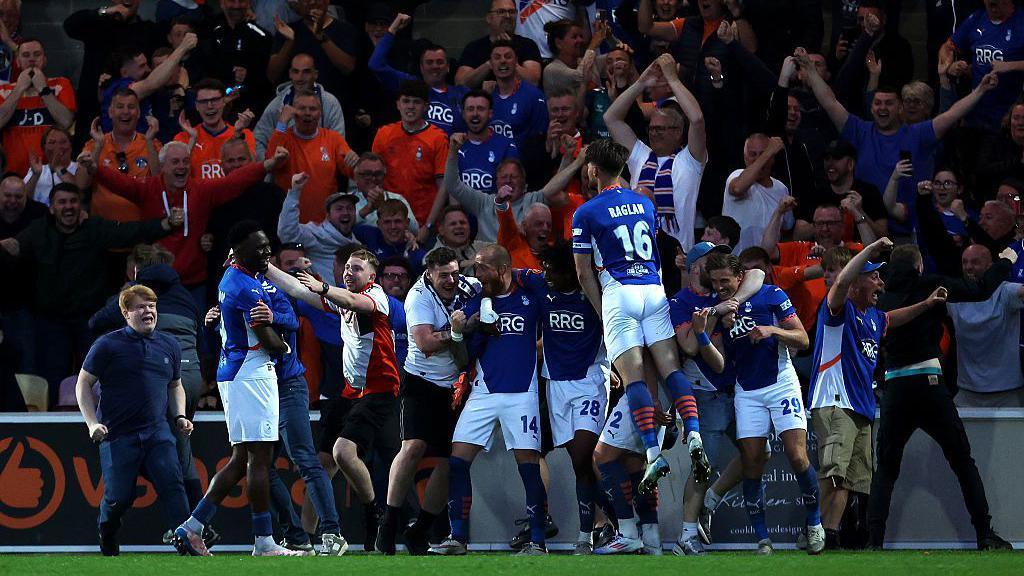
Image source, Getty ImagesImage caption, York City manager Stuart Maynard (left) and Rochdale boss Jimmy McNulty have guided their clubs to hugely impressive campaigns in the National League
CommentsWhen Rochdale and York City kick off their National League final-day title decider at lunchtime on Saturday, the result will decide who is promoted as champions - but will also have a potentially enormous impact on both clubs' respective futures.
Over 45 matchdays, the two teams have far outclassed the rest of their rivals in the fifth tier of English football, going toe-to-toe in an epic race where dropped points have been extremely rare.
Leaders York boast a two-point advantage, having amassed a whopping 107, but Rochdale have home advantage and their 10,249-capacity Crown Oil Arena has long been sold out.
Rochdale were almost down and out last weekend, but scored a 99th-minute winner away at Braintree to keep their title charge alive and deject York, whose players were watching a live stream on the pitch after they beat Yeovil.
Never before have two teams with so many points faced off in a winner-takes-all final-day decider for a place in the English Football League.
The champions will take home the trophy and be promoted to League Two, while the runners-up will need to dust themselves off and battle through the gruelling six-team play-offs.
The National League title race is so fraught with danger because the winners tend to enjoy a positive long-term future, while the runners-up often face lasting negative consequences.
Since the play-off system and its second promotion spot were introduced to the National League at the end of the 2002-03 season, the team finishing second has been promoted only six times out of 23.
During that time, there have been a fair few horror stories involving high-flying runners-up who missed out on the title by small margins then losing in the play-offs to sides who finished way below them.
In 2003-04, Hereford finished second with 17 more points than third-placed Shrewsbury, who were promoted via the play-offs instead. Hereford then finished second and missed out in the play-offs again the following year, before finally being promoted from second place, at the third time of asking, in 2005-06.
Now playing in the Championship, Wrexham endured a torrid time after finishing second on 98 points in 2011-12. They were immediately knocked out of the play-off semi-finals, and were mired in mid-table mediocrity in the National League for more than a decade before finally being promoted as champions in 2022-23.
York themselves have been here before. They were terrific last season too, earning 96 points but finishing five behind Barnet, before being knocked out of the play-offs in the semi-finals by Oldham, who had finished 26 points behind them in fifth.
While the psychology of narrowly missing out on promotion is a huge obstacle for National League runners-up, the high turnover of players every year in the fifth tier makes it hard for squads who have just come up short to build momentum in the following season - meaning a single missed promotion chance can lead to years in the doldrums.
But for the winners, the signs are hugely promising.
Since the 2002-03 revamp, not a single team promoted from the National League to League Two has been relegated straight back down the following season.
In fact, of the 43 different clubs promoted in that time, only 16 have dropped back into the National League at all in the subsequent seasons.
And never mind regression, most clubs have actually progressed further up the pyramid.
Of those 43, 24 have played at least a single season in League One, six have gone as high as the Championship and one (Luton) has even played in the Premier League.
For the National League champions, then, promotion to the EFL often leads to a huge boon, while the runners-up more likely than not find themselves trapped in the fifth tier for a while longer.