

HOUSTON — When the calendar turns to February, there’s an urgency that gets turned up that’s felt around the NBA. It’s one last opportunity to improve your team before the final stretch of the season. Front offices chase it. Fans demand it. Talking heads in sports try to speak it into existence.
We’re talking about the blockbuster trade that creates the illusion that one transaction can completely change the course of a season and take a team that wasn’t a contender and somehow deliver it a championship.
That was not the case when the Lakers pulled off one of the most shocking trades in NBA history, flipping Anthony Davis for Luka Doncic. Doncic, who had dragged the Mavericks to the NBA Finals a season earlier, could not get the Lakers back to the mountaintop.
So when Feb. 5 rolled around this year, everyone in Lakers Nation expected another seismic shift to the roster.
Instead, general manager Rob Pelinka made one quiet move.
No Giannis Antetokounmpo. No Walker Kessler. No roster overhaul. No panic swing fueled by last year’s first-round exit to the Timberwolves. Just one relatively minor move on paper: Gabe Vincent out. Luke Kennard in.
Fans in Los Angeles groaned and moaned at the restraint shown by Pelinka. They wanted more stars.
And let’s not pretend the lack of moves by the Lakers wasn’t heavily criticized in the sports world, too. It was. Loudly. Prior to the deadline there were rumors of a reunion with Kentavious Caldwell-Pope, potential targets of Andrew Wiggins and Lauri Markkanen. Even role players like Ayo Dosunmu or Saddiq Bey made sense.
Critics pointed at the Lakers’ lackluster defense and said they needed “more three-and-D players.” The chorus echoed across every sports studio show and social media timeline.
Why was Rui Hachimura, playing on an expiring contract, still on the roster?
Why was Dalton Knecht, who was traded at the deadline last year, still on the team?
If the Lakers don’t re-sign Austin Reaves, why not trade him for a superstar?
The reason is because Pelinka decided to bet on continuity. On chemistry. On the reality that sometimes the roster you already have deserves the chance to become something more than the sum of its parts.
And in their first-round playoff series against the heavily favored Rockets, that bet looks a lot smarter than the noise that buried it back in February.
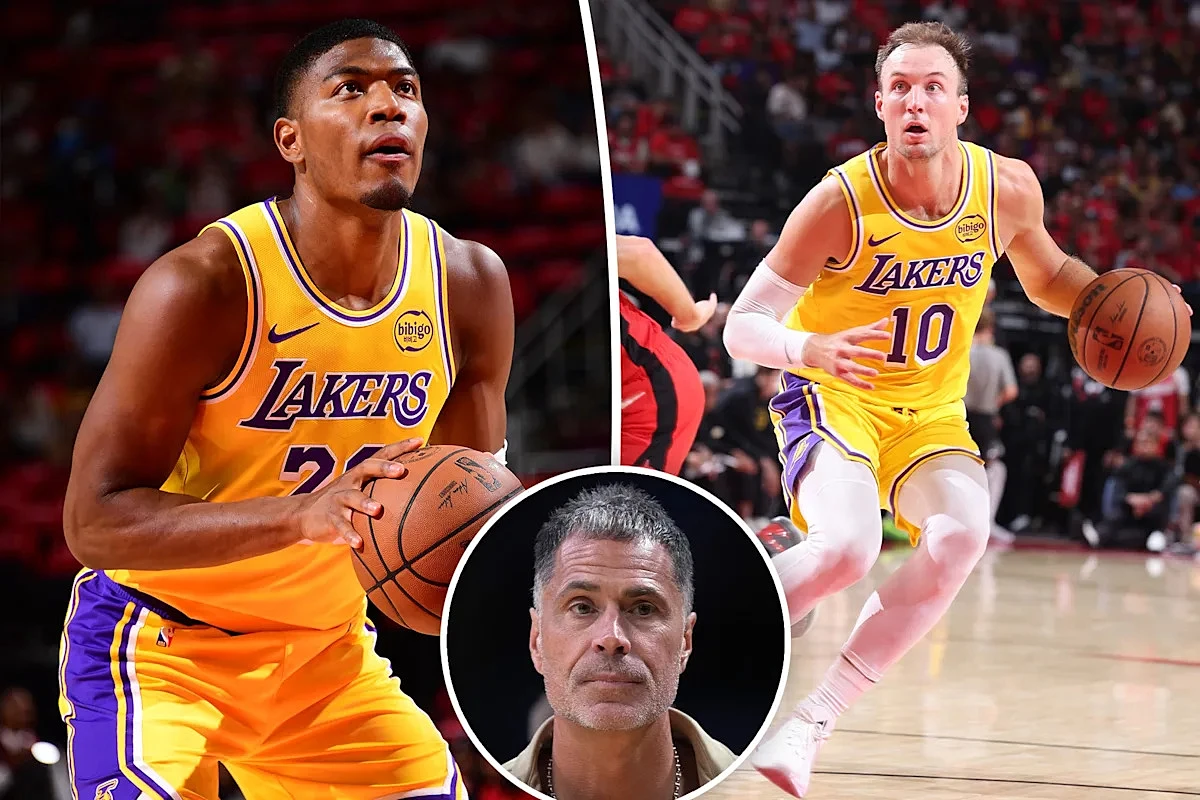
Kennard was acquired to be a 3-point specialist off the bench. Someone who could space the floor for Doncic and give him another shooter to pass to when defenses collapse on him. A clean, reliable, catch-and-shoot option on a team that had too many point guards, making Vincent expendable.
But the NBA postseason doesn’t care about your job description.
With Doncic and Reaves sidelined. Kennard has morphed into something more valuable than a sniper off the bench. He’s a stabilizer. A secondary creator and ball handler. A calm pulse in moments that usually unravel teams — like the Rockets did in the final 25 seconds of regulation in Game 3. Kennard is initiating the Lakers’ offense and making decisions that won’t necessarily show up in the box score. Oh, and by the way, he still leads the league in 3-point percentage.
And let’s not forget about Hachimura — the same player fans were ready to ship out in February. Instead, he’s back in the starting lineup with Reaves out and doing what he’s quietly done in past postseasons: producing. Efficient scoring. Physical defense. And making game-winning plays when they matter most.
It’s funny how patience sometimes gets rewarded with playoff wins.
In keeping Reaves, Knecht, Hachimura and others at the deadline, the Lakers maintained the belief in their system. In the idea that development doesn’t always have to come from outside the building. Bronny James is contributing in the playoffs, too.