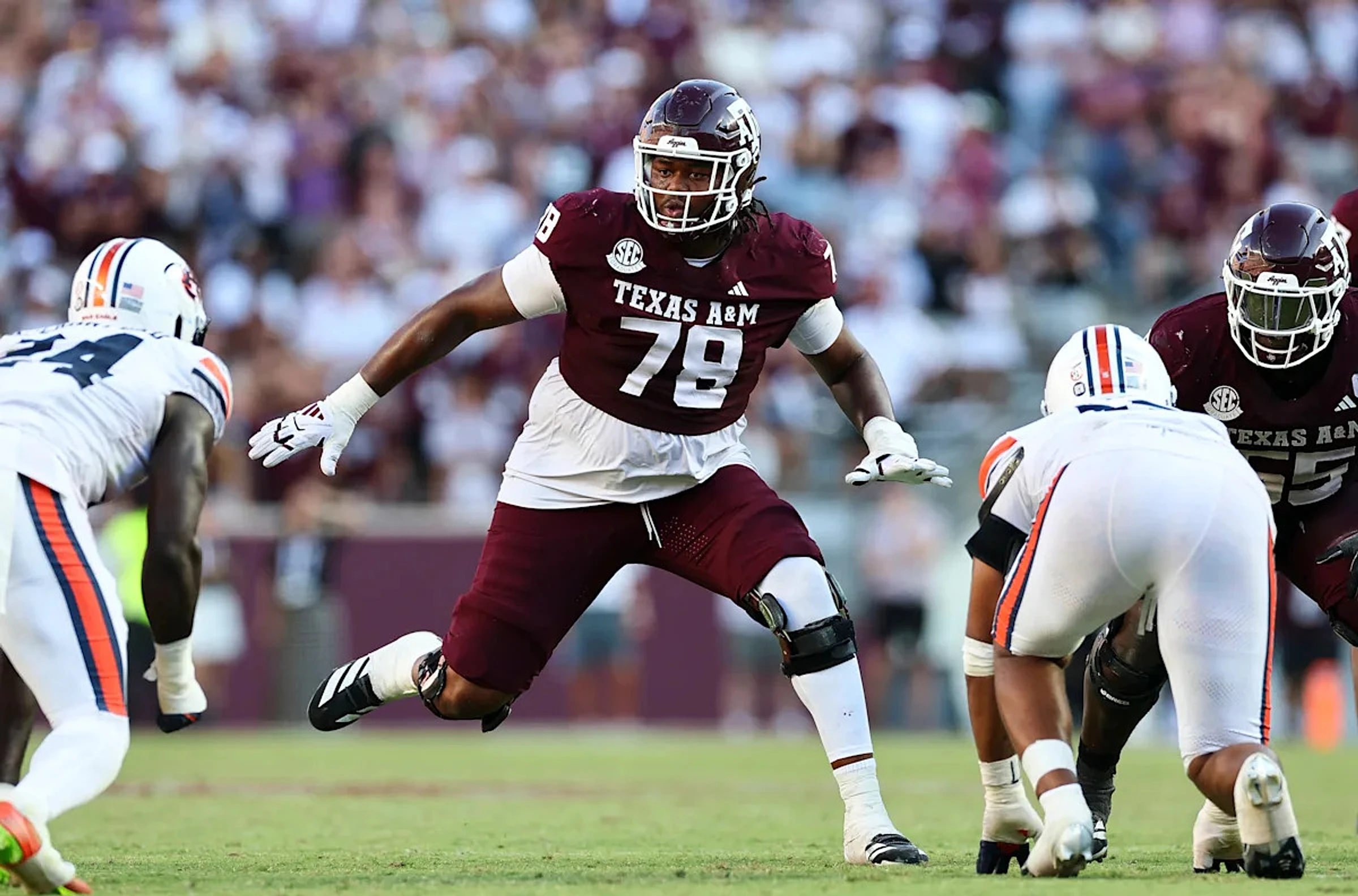


Starting with offensive tackle Caleb Lomu in the first round, the New England Patriots made nine selections in the 2026 NFL Draft. While there is some cautious optimism about the class as a whole, time will be the ultimate judge of the team’s success and whether or not the Patriots’ selections will prove their value relative to their draft position.
That more than anything else will ultimately decide how New England’s draft class will be regarded further down the road. Naturally, that is something that can only be properly assessed in a few years’ time.
As for right now, the question of value — which oftentimes is used as the basis for post-draft analysis — can only be answered in theory. This is where the Consensus Big Board compiled by Arif Hasan of Wide Left comes in. It compiles 134 big boards to see how the draft community viewed the prospects beforehand.
Obviously, there are differences between those boards and the ones used by NFL teams simply because the latter have significantly more information available. That said, more than anything the comparison between those two spheres of scouting illustrates where differences exist and where, for one reason or another, there might be a dissonance between the public evaluation of a player and how the league views him.
So, with that in mind, let’s find out how the Patriots’ 2026 draft class compares to that consensus board. (Minus means the player was drafted before it was believed to be his turn — i.e. a “reach” if that is the word you want to use — while plus means the opposite)
Pick: 1-28 | Consensus big board: 28 | Difference: 0
The Patriots moved up from the 31st to the 28th overall selection in a trade with the Bills in order to secure the last of the top-level tackles available in this year’s draft. While they had to invest some extra capital to facilitate that trade — a fourth-round pick also exchanged hands — Caleb Lomu himself was selected precisely in the range he was expected to come off the board.
Pick: 2-55 | Consensus big board: 50 | Difference: +5
Entering the draft, the Patriots had three big needs. One was addressed in the first round, with the other two both taken care of on Day 2. The first was the defensive edge, which saw the addition of Illinois’ Gabe Jacas with the 55th overall choice in the second round — a pick also acquired in a trade, this one with the Chargers for picks No. 63, 131 and 202.
Like Caleb Lomu before him, Jacas also was drafted in the same general area the consensus had him in.
Pick: 3-95 | Consensus big board: 126 | Difference: -31
The Patriots and the consensus board went hand-in-hand in the first two rounds, but New England went a different direction in the third. Eli Raridon was projected as a late fourth-round pick, ranking 126th overall. The Patriots, however, picked him 31 spots earlier than that at No. 95 overall.
Obviously, some context is necessary. For starters, there had been a run at tight ends earlier on Day 2, with seven players coming off the board in the previous 40 selections before New England was back on the clock at No. 95. The team could have gone tight end with its original second-round pick (No. 63), but edge was in even higher demand and the drop-off after Round 2 steep.
The same was true at tight end, especially considering that New England had no fourth-round pick to follow up the 95th selection. Raridon was the last stop on the train in that part of the draft, which is illustrated by the next TE getting picked all the way at No. 133. The Patriots, meanwhile, were next on the clock at No. 171, right in the middle of another tight end cluster.
Raridon was a reach compared to the consensus board, but the circumstances made it a worthwhile one in the team’s eyes.
Pick: 5-171 | Consensus big board: 512 | Difference: -341
Now, this is where the fun begins. Karon Prunty was one of the biggest reaches in the draft before the true late-round fliers in the seventh round: he was selected a full 341 picks higher than his big board rank and thus the only player in the top 200 with a big board rank above 400.
His ranking isn’t the only noteworthy data point, though. Prunty’s ranking also had a variance of 60.3. What does this mean? Using 100 as the base, every variance score higher suggests polarization and everything lower consensus. This means that the draft community was pretty much in agreement: the Wake Forest cornerback was nowhere close to being drafted.
There is a clear difference between how the league viewed him versus what the experts saw in him. Prunty, for example, was no under-the-radar player; besides the Patriots, other teams like the Packers and Panthers also brought him in for pre-draft visits. Ultimately, it was New England pulling the trigger at No. 171 after an extensive research process.
It remains to be seen whether the apparent gamble pays off.