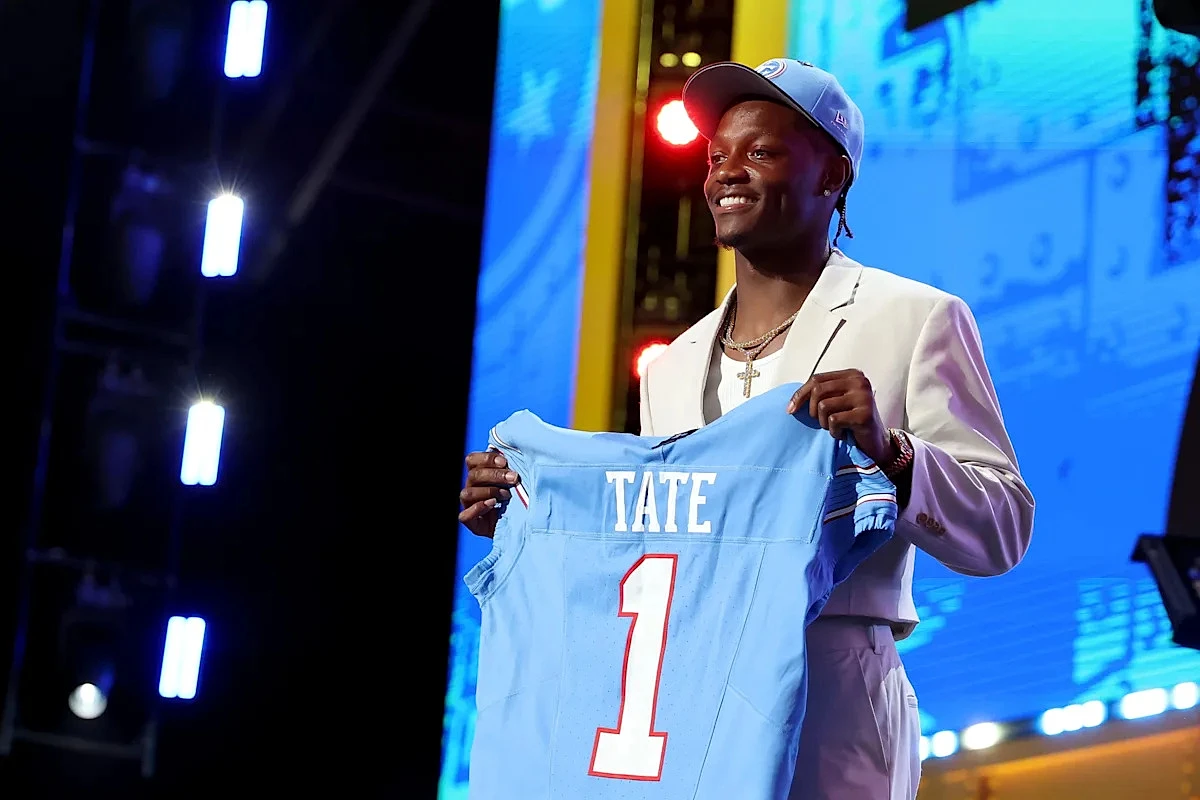


It feels like the Tennessee Titans were destined to draft a former Ohio State Buckeye football player when it was time for them to make their selection at fourth overall. However, they pulled a shocker by selecting wide receiver Carnell Tate over his defensive teammates Arvell Reese and Sonny Styles.
That meant that getting quarterback Cam Ward additional weapons was the No. 1 priority in Tennessee.
Titans general manager Mike Borgonzi spoke to reporters at the conclusion of the first round and mentioned that they thought he was the best receiver in the draft. He also mentioned how great he thinks he'll be for their offense and Cam Ward due to his "exceptional ball skills" among other things.
Want to know what Tate's scouting report was before his selection? Here's a look back at what his pre-draft scouting reports were ahead of the 2026 NFL draft:
Tate was a productive contributor during his first two seasons at Ohio State before a breakout season in 2025, when he averaged 17.2 yards per catch on 51 receptions and scored nine touchdowns. He missed three games during the second half of the season due to a calf injury and was never quite the same upon his return against Michigan and in two College Football Playoff games.
Tate is a tall, sturdy, and savvy route-running perimeter receiver who developed into a contested-catch machine in 2025 (85.7 percent). He’s not overly dynamic after the catch but he’s a craftsman on deep routes and projects as one of the highest-impact NFL-ready receivers in this talented class. Tate excels as a vertical route runner—he sets defenders up and uses subtle movements to create downfield separation and plays much faster than his 40 time suggests. He attacks the ball in the air and is good at plucking it over his head and away from his frame. He has strong hands in traffic and tracks the ball smoothly over his shoulder. Tate improved his contested-catch rate from 54.5 percent in 2024 to 85.7 percent in 2025.
Tate transitions upfield after the catch relatively quickly and his size and movement can make it difficult for defensive backs to bring him down. However, outside of his one-cut-and-go move, he might lack the twitch and change-of-direction skills to make defenders miss and generate a lot of YAC yards in the NFL. Like most OSU receivers, he’s an effective blocker in the run and screen game.
Ohio State has turned into Wide Receiver U, with Emeka Egbuka being the most recent star wideout to come out of Columbus. And while most of the college football world focused on Jeremiah Smith (who isn't eligible for the 2026 draft), Tate put up some serious numbers and showed why he is a top prospect for this class. Tate produced big plays on a regular basis, averaging 17.2 yards per catch last season. He is a precise route runner, has great hands and displays outstanding body control. And he'll also happily block for ball carriers, which NFL coaches love to see.
Ascending “Z” receiver who continues to step out from the shadow of Ohio State teammate Jeremiah Smith. Tate has good size but would benefit from more play strength. He builds momentum quickly on intermediate and deep routes, utilizing speed and tempo to pressure cornerbacks. He can win over the top on verticals or separate over the first two levels with route savvy and separation burst. Tate tracks throws at top speed and makes his adjustments to run under them. He combines timing, body control and catch radius to dominate air space and consistently lands on the winning side of contested catches. Pass catching comes effortlessly with soft, strong hands and he consistently works back on throws to keep ballhawks from hawking. Tate displays rare polish for a player his age and has the talent to become a heralded pro within his first three seasons.
A two-year starter at Ohio State, Tate was an outside receiver (88.9 percent of snaps aligned wide) in former offensive coordinator Brian Hartline’s pro-style, balanced scheme. Playing in a program full of NFL receiving talent, he teased his ability as a freshman and was a solid contributor as a sophomore before emerging as a junior as one of college football’s best pass catchers. Tate caught 77.3 percent of his targets in 2025, best among the 183 FBS receivers with an average depth of target of 12 yards or more.
Thanks to his tall, angular frame, Tate eats up ground with long strides and uses gear changes to establish leverage or create vertical separation. He has only average snap out of breaks, but wins more with pacing and body control than suddenness. He tracks with a sense of calm when the ball is in the air and skillfully syncs his movements and catch-point adjustments. He climbs the ladder with ease, and the ball doesn’t move when it hits his hands (among the 168 FBS receivers with at least 66 targets in 2025, Tate was one of only four who didn’t register a drop).
Ohio State has been a factory for NFL receiver talent in recent years, and Tate will continue that tradition in 2026. With the Buckeyes, Tate was never the true No. 1 receiver, as Marvin Harrison Jr. and Jeremiah Smith were the featured receivers. However, like Emeka Egbuka, Tate has still impressed with a good set. Tate flashed as a freshman in 2023, catching 18 passes for 264 yards and a touchdown. In 2024, Tate had 50 receptions for 698 yards and four touchdowns as the No. 3 receiver behind Smith and Egbuka. In 2025, Smith was the starter across from Smith and had an impressive season. In 2025, Tate had 51 receptions for 875 yards with nine touchdowns
For the NFL, Tate is a tall, long receiver with surprising speed for a big receiver. With his size, Tate is a red-zone weapon and provides a size mismatch to make leaping catches over defensive backs. Tate is phenomenal on jump balls, using his height, long arms, and leaping ability to make acrobatic catches over defensive backs.
While Tate has good size, he has enough speed to generate separation and some surprising twitch for a tall wide out. Tate can run well to work on defenses downfield and threaten them at all levels. He is a long-strider with a second gear that can explode in the open field with the sheer speed to run away from defenders. Tate shows some nice run-after-the-catch ability and is a threat on screens. In the NFL, his speed will be diminished somewhat, but there is no doubt that Tate has above-average speed for a big wideout.
In the 2026 NFL Draft, Tate looks like a first-round pick and could be starting as soon as his rookie season. As a pro, he may not be a No. 1 receiver but should be a very good No. 2, similar to Tee Higgins.
Tate is a polished, technically sound receiver who wins with precision, body control, and an understanding of coverage structures that most college wideouts simply do not possess. The combine didn't change a thing about his evaluation for me. He was never going to test like Tyreek Hill, and he was never supposed to. His game lives in the intermediate zones, in the way he manipulates leverage at the top of routes, in how he high-points throws over tight coverage, and in the dependability he brings on third down. He reminds me more of Chris Olave's profile than Garrett Wilson's coming out of Columbus. That is not an insult. That is a very good football player with a long career ahead of him.
The scheme conversation matters more for Tate than it does for most receivers in this class. West Coast concepts, timing-based passing games, and offenses that value intermediate accuracy over vertical shot plays are where he will do his best work. He thrives in that 10-to-20-yard window, finding soft spots in zones and converting money downs. A system that asks him to beat press coverage on every snap and win deep as its primary plan of attack would be underusing what makes him special. Put him in a structured offense with a quarterback who trusts timing, and you are going to see a productive starter from Week 1. Brandon Beane can joke all he wants on national television, but the tape and the production speak for themselves, and NFL decision-makers know it.
The floor with Tate is high, and that should not be overlooked. He played alongside elite talent throughout his time at Ohio State and still demanded targets when defenses had every reason to bracket Jeremiah Smith and let someone else beat them. His championship experience, his academic profile, his leadership traits all point to a player who will handle the transition to the professional level without a hitch. The question teams will wrestle with is not whether he can play. It is whether his physical limitations keep him from ever becoming the true number-one option in an offense. In a league starved for reliable, smart, productive receivers who contribute from Day 1, that question might matter less than some think.
Carnell Tate is PFSN's WR1 in the 2026 NFL Draft, and a true X-factor in waiting. He first showed promise with a 52-733-4 receiving line in 2024, producing in spite of his place as the Buckeyes' third option alongside Jeremiah Smith and first-round NFL Draft pick Emeka Egbuka. But in 2024, Tate's technical feel was still underdeveloped.
He was primarily a vertical threat for Ohio State, who lacked polish. He flipped the script 180 degrees in 2025, reinventing his game and becoming a true route running expert with rare sink, throttle control, and stem IQ for his size. Tate still has the long-strider range, body control, and logic-defying catch-point focus that makes him so potent in 50-50 situations (he boasts a jaw-dropping 28.2% catch rate over expectation, per TruMedia), but at the same time, he's a deadly multi-level separator who can win 1-on-1, convert on clutch downs, and generate big plays.