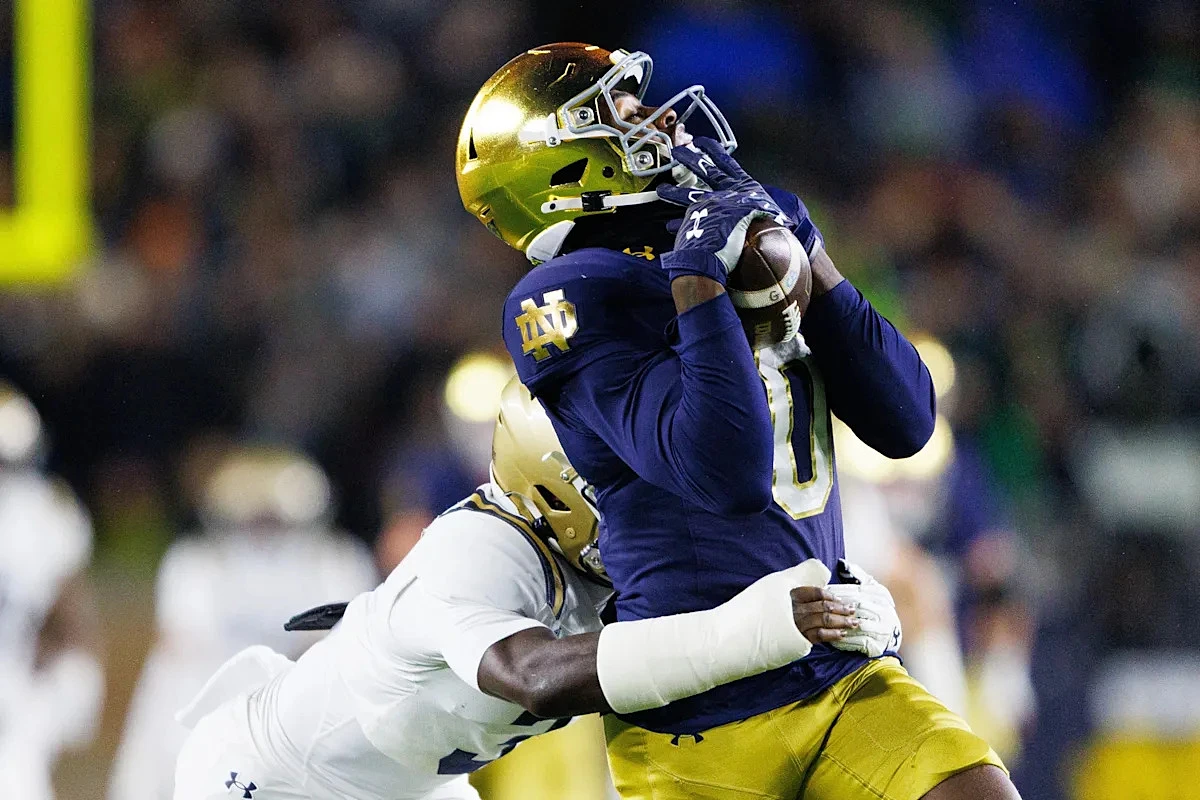


The New York Giants wrapped their Day 2 of the 2026 NFL draft by trading up with the Cleveland Browns in order to select Notre Dame wide receiver Malachi Fields with the 74th overall pick.
While debate rages over the value of that trade, general manager Joe Schoen and head coach John Harbaugh are more than pleased with their decision.
"Fields is a player we coveted coming into the draft. As things started to fall and he was still there, and some of the receivers went already, an opportunity to go get him," Schoen told reporters.
1 / 14New York Giants vs. Dallas Cowboys: Best photos from Week 18Dallas Cowboys (home, away)
"We thought the value was -- we were fine with the value, and we were able to secure the player we wanted at a position we wanted to upgrade, not only the size, length, athleticism, another phenomenal kid that will come in and be a really good addition for us."
Here's a look back at what the pre-draft scouting reports had to say about Fields.
A one-year starter at Notre Dame (and three-year starter overall), Fields was the boundary receiver in offensive coordinator Mike Denbrock’s scheme. A high school quarterback, he transitioned well to receiver at Virginia before transferring to the Irish for his final season in 2025. His targets and production took a nosedive with a freshman at quarterback (he didn’t record a 100-yard receiving game in 2025), although he produced several memorable plays.
Fields flashes both build-up speed and short-area juice, along with a go-and-get-it gear when the ball is in the air. He displays impressive reflexes at the catch point and deftly takes advantage of every inch of his frame to reel in throws. NFL coaches will like the way he uses his hands and feet to gain a step of separation out of breaks, although they will want to see him expand his route proficiency (there is a healthy amount of hitches and go routes all over his tape).
Boundary “X” receiver who uses elite size and strength to bully defensive backs. Notre Dame’s run-heavy approach and quarterback play slowed Fields’ production somewhat but his tape was filled with impressive moments. He’s best suited for an offense that allows him to get from Point A to Point B while using his frame/ball skills to dominate the work space and win in the air. He can be a slow starter versus press and lives on contested targets, but he moves the chains on tight-window throws and consistently tilts 50/50 balls in his direction outside the numbers. Fields might never be a star, but his traits, playing style and ball skills should make him a productive WR2 in time.
He does a beautiful job of tracking, adjusting, and attacking the ball downfield. While he’s not fast (as confirmed by a 4.61-second 40 at the combine), he has borderline shocking suddenness and the ability to drop his weight without gearing down. His 6.98-second three-cone speaks to that body control and redirection quickness. He’s one of the best receivers in this class at tempoing his routes. He does need to improve his release package versus press-man, especially in the quick game and in confined space in the red zone.
Fields’ analytical profile scares NFL teams. Some numbers that jump out: He’s had fewer than 2 yards per route run in his career, which isn’t the typical kind of stat for a receiver taken in the first two rounds. Also, 26 percent of Fields’s career targets were contested, and his open target rate is one of the worst among the draftable receivers in this class. Finally, he ranks in the top five in this class of receivers in career contested targets, with 74, but he hauled in only 47 percent of them.
His blocking in the run and screen games improved throughout the 2025 season after an abysmal start. He still doesn’t show enough aggressiveness and attention to detail for a player his size. He’s often too comfortable to exit along the sideline.
Fields is a throwback in a lot of ways. In a league that keeps chasing speed and separation, he wins the old-fashioned way: by being bigger, stronger, and more physical than the guy across from him. The ball skills are legit. When the quarterback puts it anywhere near his zip code, he comes down with it more often than not, and that ability to dominate contested situations translates directly to the red zone and on third downs where tight windows are the norm, not the exception. His understanding of zone coverage and his instinct for finding soft spots are tools that will show up early in his NFL career.
The concerns are real, though, and they are worth taking seriously. At the NFL level, corners who can match his length and get physical at the line are going to give him trouble if that release package does not improve. He is not going to run past anyone, so if he cannot win at the line and create some early separation, he is going to live on contested throws for his entire career. That is not a death sentence by any means, but it does cap his upside and makes him more quarterback-dependent than you would like. The short-area game is another limitation. He is not someone you are going to scheme touches for underneath and let him do damage in space. His value is between the numbers and beyond them.
The right offensive system will make all the difference for Fields. He needs to be deployed as a boundary receiver who works the intermediate-to-deep part of the field, wins on back-shoulder throws and fades, and serves as a go-to target in the red zone. Put him in a scheme that asks him to run a full route tree and create for himself on every down, and the limitations will show up fast. But pair him with a quarterback who trusts arm talent and ball placement, and Fields can absolutely be a productive starting receiver who moves the chains week after week. He is never going to be a WR1, but as a complementary piece who does the dirty work and comes up big in clutch moments, his skill set has real staying power at this level.
In 2025, Fields transferred to Notre Dame and took on a role as the Fighting Irish's resident deep threat, accounting for 36 catches, 630 yards, and five scores.
He averaged over 17 yards per reception, achieved a miniscule 1.6% drop rate, and earned a respectable PFSN WR Impact score of 78.3. At 6'4", 218 pounds, with 32 1/2" arms, Fields makes his money as a contact brawler and contested catch presence first, and a separator second. His Senior Bowl showing boosted his stock across the industry, but even there, his best play was a diving downfield catch in a high-variance situation.
With his build, Fields brings questions regarding his max-level athleticism, vertical speed, and separation upside with lacking flexibility and deceleration. That said, there's no denying his ability to control the catch point with timing, box-out ability, and vice-grip hands, and his heavy-handed run blocking ability solidifies his value as a rotational WR early on. With good athletic testing, Fields can improve his chances of going Top 100, but needs to keep refining his game as a multi-level separator before he can be a full-time NFL starter.
For the NFL, Fields is a tall, long receiver who is a red-zone weapon and provides a size mismatch for the NFL. He is a dangerous red-zone threat given his massive wingspan, height, leaping ability, and strong hands. Fields is a possession receiver who is capable after the catch, as he will dart into the secondary and power his way through defensive backs after making short catches on slants, crossers, and digs. On back shoulder throws or jump balls, Fields is very skilled at boxing out defenders and making the catch over them. On 50-50 jump balls, Fields is a dynamic playmaker.
Fields is not a burner wide receiver who is going to torch NFL cornerbacks with speed. Higgins lacks a second gear and has one play speed through his routes. He is a long strider that lacks twitchy quickness. Thus, he could have separation issues with some pro cornerbacks.