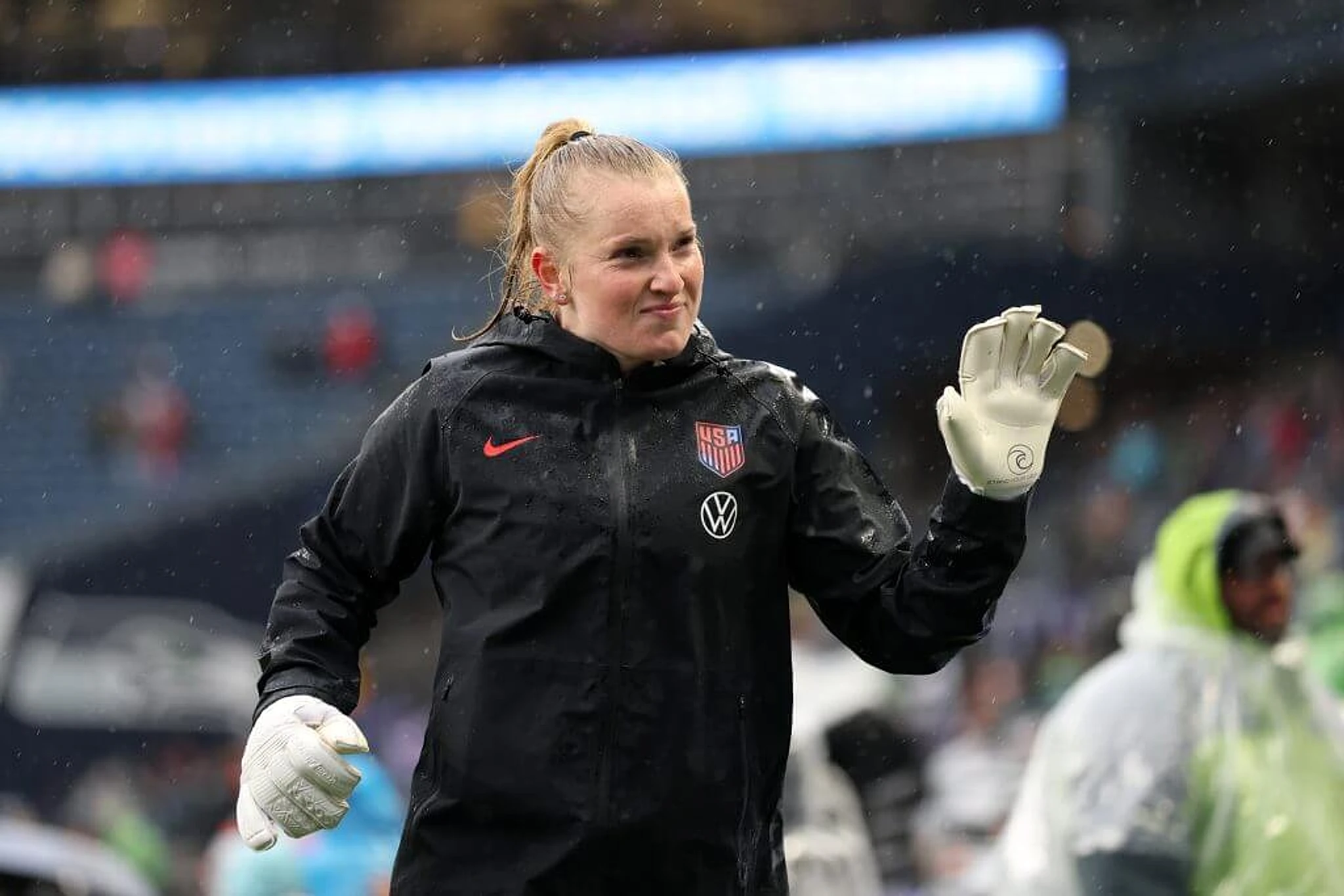

Just over a year ago, the discourse surrounding the up-for-grabs No. 1 shirt on the U.S. women’s national team concerned how open-ended the question was. That in itself was unfamiliar territory until Alyssa Naeher’s retirement from international soccer in November 2024 threw the gates wide open, exposing U.S. Soccer’s lack of a succession plan in the process.
Now there are two clear candidates for the position. Both goalkeepers have aquatic nicknames: Phallon Tullis-Joyce, a marine biologist affectionately referred to as an octopus for her long-limbed exploits, and Claudia Dickey, whose name inspired her USWNT and Seattle Reign teammate Lynn Biyendolo to dub her “Claw-dia,” complete with a song and jig.
As the clock counts down to the 2027 World Cup in Brazil, the factors separating Tullis-Joyce and Dickey are sharpening into focus. The difference could come down to their skill with the ball at their feet, rather than what they can do with their hands. Where Tullis-Joyce was once the frontrunner, Dickey now has an edge.
For this week’s three words, we’re diving into the waters of the USWNT goalkeeper competition…
Tullis-Joyce and Dickey were once club teammates. Tullis-Joyce joined the Seattle Reign in April 2021 from Stade de Reims in France, and she was joined by Dickey in January 2022 when Seattle selected her 20th overall in the NWSL draft.
Tullis-Joyce was No. 1, and by the time she signed with Manchester United in September 2023, she had played 3,422 minutes and made 107 saves for Seattle, helping them win an NWSL Shield in 2022. The University of Miami alum left the Pacific Northwest with a joint-club record of 13 regular-season clean sheets, shared with Hope Solo. Octopus-themed Reign shirts with her name on them are still available on Etsy.
Tullis-Joyce’s tentacles have taken well to Manchester. Last season she secured a Women’s Super League Golden Glove for the most clean sheets in a season (13, alongside Chelsea and England goalkeeper Hannah Hampton), which helped United qualify for the Champions League for the first time. Tullis-Joyce’s international club career may have been quieter than some of her U.S. teammates who play abroad, but the spotlight has a way of finding you when you spend your days off squirting blood around the zoo to feed a Komodo dragon.
“I think Manchester United’s prepared me very well, especially being in the WSL. At this point, every game is a final,” Tullis-Joyce said from USWNT camp after a 1-0 win over Canada in the SheBelieves Cup last month. “So I think I’ve prepared pretty well and will continue to be prepared pretty well for moments like these for the U.S. women’s national team.”
Meanwhile, in Seattle, Dickey has stepped into the No. 1 role and established herself as an invaluable last line of defense. Earlier this season she broke the club’s regular-season clean sheet record with 14 and is currently tied with Solo for most saves in club history at 187.
“The data don’t lie. Claudia Dickey’s probably the best performing goalkeeper in the NWSL this season,” USWNT head coach Emma Hayes said last May after inviting Dickey to her first national team camp — careful as ever with her wording, as Dickey’s primary competition plies her trade in a different league.
Tullis-Joyce earned her first cap last April in the first of two friendlies against Brazil. Dickey’s came a few months later in June against Ireland. (Hayes had given Europe-based players like Tullis-Joyce the summer off during that window.) Both marked their national team debuts with clean sheets. Tullis-Joyce looked to be the first-choice keeper as recently as last fall, starting the USWNT’s first of two friendlies against Portugal. The U.S. lost the first 2-1. Dickey started the redemption leg, which resulted in a 3-1 victory.
A month later, Tullis-Joyce fractured her eye socket and was out several weeks for club and country, which included the USWNT’s final friendlies of 2025 against Italy. Dickey played, adding two more clean sheets to her international tally.
This might have been where a subtle shift happened between Tullis-Joyce and Dickey. Hayes has made references to her desire for the USWNT’s primary goalkeeper to be comfortable with the ball at their feet, distributing from the back.
“Our starting point is always our model and what we look for in our goalkeepers on both sides of the ball,” Hayes said last week in Seattle ahead of the U.S.’s second match against Japan.
“Second of all, you have to be mindful that, let’s say, for example, we want our goalkeeper to be competent in short and long builds, but they play for a club that don’t want to build short, so acceptance of that, but know that they might have to keep developing in that area because it’s a prerequisite for this team. For example.”
As with field players, Hayes is interested in developing goalkeepers beyond the 2027 World Cup, and noted that she and her coaching staff have always aimed to have two goalkeepers at the ready in a major tournament.
Holding each keeper’s club campaigns next to each other sheds light on the differences in their game. According to Fotmob, in the 2024-2025 WSL season, Tullis-Joyce made 325 successful passes at a 65.7 per cent accuracy rate and played 67 long balls with 28.8 per cent accuracy. In the NWSL last season, Dickey made 736 successful passes at a 72.7 per cent success rate, and played 123 long balls with 31.6 per cent accuracy.
That is perhaps the honest data Hayes referred to, and it held up to the eye test during the latest international window; it wasn’t just that Dickey appeared more at ease playing the ball to the defenders and midfielders in front of her, but vice versa as field players found her as an option behind them to reset a play.
What distinguishes Tullis-Joyce is the same combination of instinct and physical attributes that likely inspired her nickname. Her height (6ft; 185cm) and agility would have already set her apart, but her reaction time allows her to make saves that defy expectation, statistical or otherwise.
“I think we push each other,” Dickey said of the competition among the goalkeepers in camp from the mixed zone following the first USWNT game against Japan in San Jose. She also referenced the influence of the Houston Dash’s Jane Campbell, who was called up, but did not play.