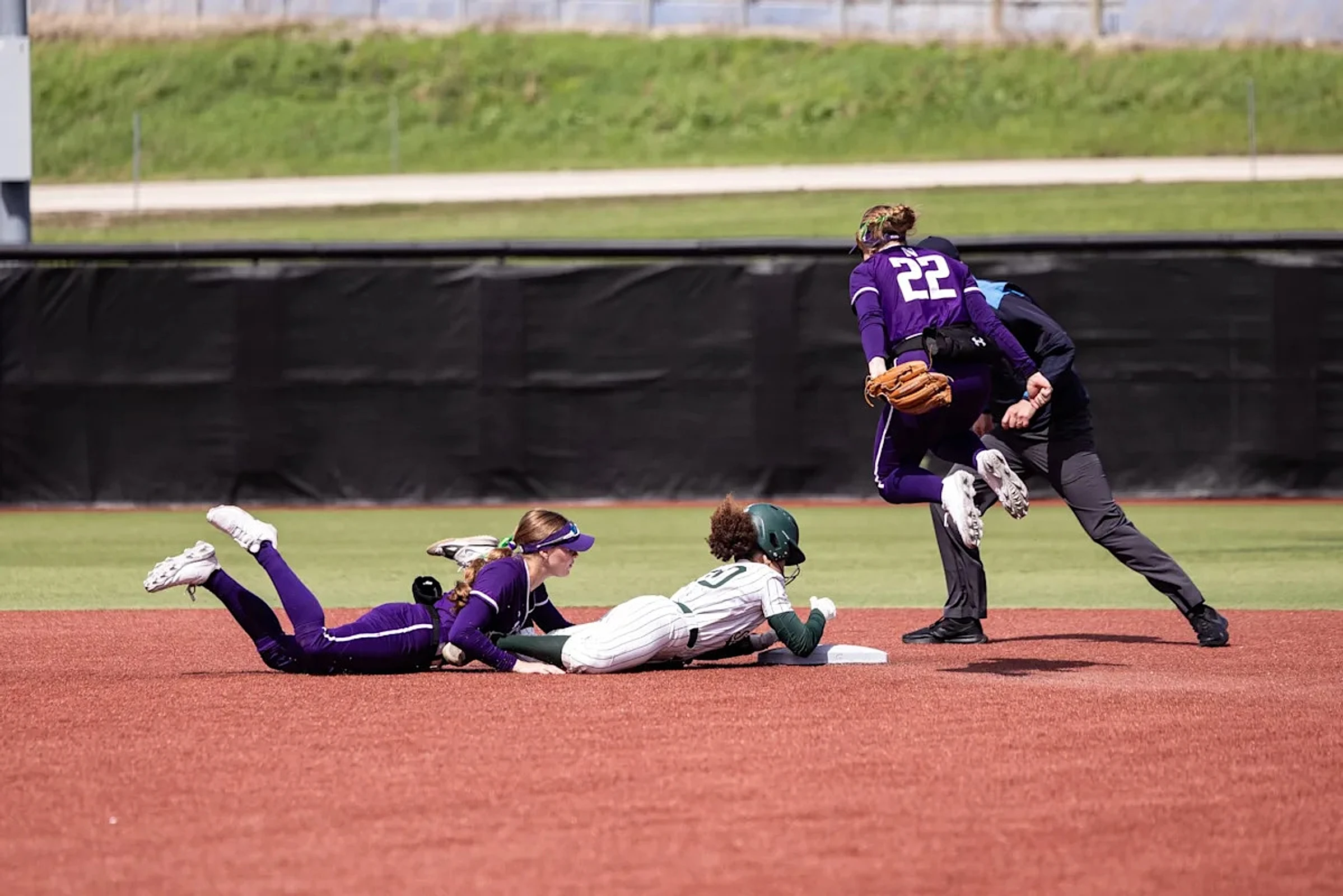


Truthfully, it is nice to see this team victorious, and I’m glad things seem to finally be going right. But this last weekend is slightly reminiscent of a certain weekend in Kentucky, where NU faced less-than-good teams and took care of business in all but one game.
But before we get to that, here are some facts. 2011 was the last time Michigan State defeated Northwestern. After that, there have been 25 consecutive wins for the ‘Cats and counting — because the tally just increased by three after a weekend sweep.
If Northwestern failed to sweep, I would have, for lack of a better term, crashed out. Michigan State played sloppily at best. Its pitchers had some of the worst starts to their careers; there were more wild pitches to the backstop than I have ever seen, silly errors plagued every avenue of the contests and the Spartans could not see the ball to get a hit (disregarding the “problem game”).
With this in mind, it’s hard to believe a team that hadn’t won against the purple and white in 15 years almost bested the ‘Cats in game two. Adding to the shock, the Spartans only had one hit in game one and two hits in game three to end up in two shutouts.
So what happened in that second contest? It’s no secret that Northwestern tends to drop off in the series after game one. Maybe that ties into trusting the “depth” in the bullpen instead of pushing Mason to the brink of exhaustion, but the numbers do tell a story.
For example, runs allowed increase by 26% from game one to two; if you took a random error from conference play, there is a 38% chance it came in the second contest; strikeouts increase by 14% between the two matchups.
So whether it’s offense, defense, weather conditions or your pick of anything, there is clearly something going on in that second game. For this week’s series, I have two reasons for the narrow victory.
Riley Grudzielanek started in the circle, and early on, things looked comfortable. Through two innings, she held the Spartans scoreless — a complete flip from last weekend’s start in Penn State, where she gave up three runs in 1.1 innings and promptly left for the dugout.
But this couldn’t last forever, and her final stat line read as eight hits, four walks and five runs through four innings. The third started the trouble: two hits, two walks, an RBI groundout and a wild pitch scored three to put the game slightly within reach. Then, after a stifled Northwestern offense, the Spartans tallied two more in the fourth after four more hits.
Keep in mind that the day before, MSU only managed one hit. On Saturday, in four innings, it had seven. Some of that can be chalked up to placement, with balls finding gaps and dropping just out of reach, but over time, that explanation runs thin. What it more clearly suggests to me is a lack of control; Grudzielanek is failing to find her tempo and productively attack the zone.
She’s leaving it too much over the plate in counts she’s ahead in, and she failed to force the chase. When the junior is on, she can certainly dominate. But when she’s not, it’s clearly detrimental to the team. Unfortunately for the purple and white, the version that usually shows up is the latter, as she currently holds a 9.50 ERA in conference.
With the lead shrinking, Kate Drohan turned to Renae Cunningham in the fifth. The results weren’t immediately settling, though, and Cunningham allowed two hits right away. She was bailed out only by a chaotic, momentum-saving double play between the plate and second base that prevented further damage. The following inning followed a similar pattern, however: more traffic, more pressure and eventually a call to Marina Mason to close.
Now, if you read last week’s column, you know that typically doesn’t go well. The first-year did her best, of course, but in the process, the Spartans plated two more and tied the game at seven.
Yes, the game was tied. A team that had been outscored 67-20 in the 10 matchups leading up to last weekend had tied it up with the Wildcats.
Grudzielanek and Cunningham allowed 41.38% of their batters to battle into five-plus pitch at-bats. This makes sense as Grudzielanek maintained a 55.77 strike percentage and Cunningham recorded a marginally better 61.11%. What also contributed were the five extra-base hits allowed — games one and three had one total.
Now, all of this might not have mattered in the grand scheme of things if the Northwestern offense hadn’t made things so close, either.
Michigan State committed six errors in Saturday’s contest, and on paper, that definitely should have been more than enough for Northwestern to run away with the game. Truthfully, against that kind of defensive sloppiness, the expectation is that a lineup creates separation. Instead, Northwestern largely took only what was given.
The missed opportunity in the fifth exemplifies my point. A throwing error by the MSU first baseman immediately put Donahey in scoring position, perfect for an easy rally. Instead, it took a sac bunt and a pop-up to move her across the plate. Then, with two outs, a rally was exponentially difficult to create, and the cost was immediate.
With only one run to show for the error, the game remained in reach, and the Spartans capitalized by tying it the very next inning. If Northwestern extends that rally, if it strings together even one more quality at-bat, the entire trajectory of the game changes. Instead, the inability to turn a mistake into a crooked number kept the pressure on and erased any margin for error.
The numbers further reinforce my point: the ‘Cats only scored .83 runs per error, an underwhelming return at best. In innings where Michigan State committed errors, Northwestern recorded only two hits total, meaning it rarely stacked quality at-bats on top of defensive breakdowns. Those are supposed to be rally innings, moments where one mistake keeps snowballing, and the offense keeps applying pressure. But this never consistently happened.