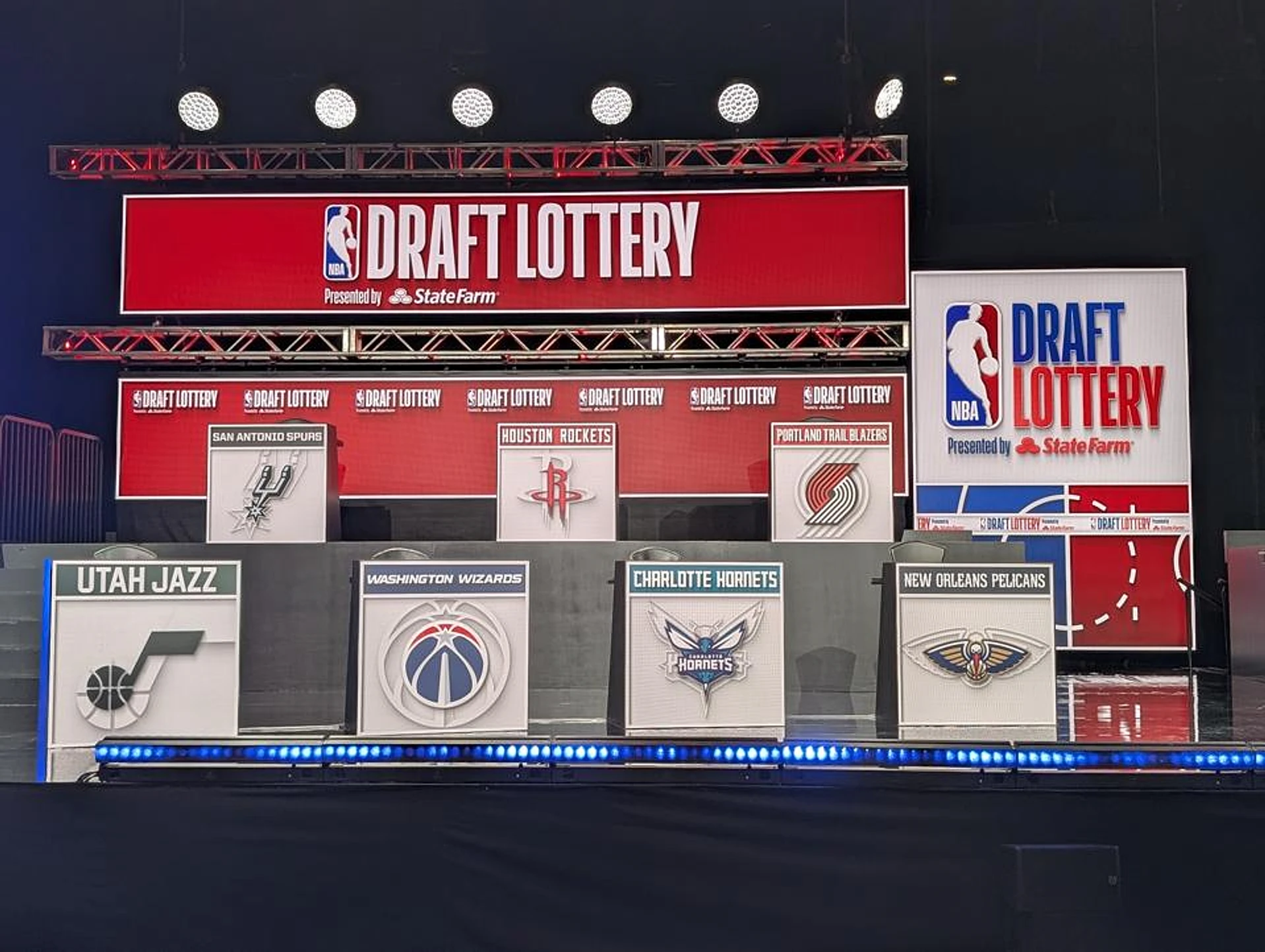


CHICAGO, ILLINOIS - MAY 12: Players, team members and other participants gather to attend the NBA Draft Lottery in Chicago, Illinois, United States on May 12, 2025. (Photo by Jacek Boczarski/Anadolu via Getty Images)
The NBA has been on the warpath over the past few months to fix the scourge of tanking. On Tuesday, details of its proposed solution trickled out.
As ESPN's Shams Charania first reported, the NBA is proposing a complete overhaul of its draft lottery. It would expand the lottery from 14 teams to 16 teams, decrease each team's chances of winning the No. 1 overall pick and further penalize the teams with the three worst records in the league.
The proposed "3-2-1 lottery" would assign three lottery balls to the teams with the fourth- through 10th-worst records, two lottery balls to the teams with the three worst records and the Nos. 9 and 10 seeds in each conference, and one lottery ball to the team that loses the No. 7 vs. No. 8 game in the play-in tournament.
Unlike the current system, which draws only the first four picks before sorting the rest of the lottery in reverse order of standings, all 16 picks would be drawn in the new lottery. The teams with the three worst records could fall no lower than No. 12, while the other 13 teams could all fall as low as No. 16.
Additionally, no team will be allowed to win the No. 1 overall pick in back-to-back years. Teams also won't be allowed to win three straight top-five picks.
If approved, this new lottery format should do what it set out to do. Teams will have far less incentive to engage in the sorts of tanking shenanigans that have been on display in recent years, from sitting healthy players to pulling starters out of competitive games.
However, the NBA should be mindful of the law of unintended consequences before approving this proposal. While the current format should wind up fixing tanking, it might create an even bigger problem.
At its core, the entire purpose of the NBA draft is to give hope to otherwise hopeless teams.
Not every high lottery pick is guaranteed to pan out, of course. For every LeBron James or Victor Wembanyama, there's a Greg Oden, Anthony Bennett and Markelle Fultz. But the probability of finding a franchise-changing superstar is highest at the top of the draft and rapidly descends the further down the board teams go.
In recent years, teams have often needed multiple trips to the lottery before digging their way out of a rebuild. The Oklahoma City Thunder became a dynasty in the making in part because they landed Josh Giddey (No. 6 in 2021), Chet Holmgren (No. 2 in 2022) and Jalen Williams (No. 12 in 2022) in back-to-back years. The Detroit Pistons went from the league's basement to a 60-win team in two years only after adding Cade Cunningham (No. 1 in 2021), Jaden Ivey (No. 5 in 2022), Jalen Duren (No. 13 in 2022) and Ausar Thompson (No. 3 in 2023).
The team that’s threatening to knock them out of the playoffs, the Orlando Magic, landed Jalen Suggs (No. 5 in 2021), Franz Wagner (No. 8 in 2021), Paolo Banchero (No. 1 in 2022) and Anthony Black (No. 6 in 2023) within a three-year span. The up-and-coming Charlotte Hornets also needed multiple lottery picks to find their core of LaMelo Ball (No. 3 in 2020), Brandon Miller (No. 2 in 2023) and Kon Knueppel (No. 4 in 2025).
Small-market teams in the midst of a rebuild have little hope of landing a marquee free agent, particularly with more of those players signing extensions and eschewing free agency entirely. That leaves the draft and trades as their only two real avenues to land difference-makers.
This new lottery format could make it far more challenging for the league's cellar-dwellers to dig their way out.
Under the current system, the appeal of tanking isn't just maximizing your chances of landing the No. 1 overall pick. It's also locking in the floor that you can't fall below.
Since only the top four picks are drawn, the team with the worst record can't slip lower than No. 5. The Utah Jazz and Washington Wizards tanked so egregiously this season because they owed their 2026 first-round picks to other teams if they fall below No. 8. They did everything in their power to finish with a bottom-four record to ensure those picks would not convey.
That won't be possible in the new format. The teams with the three worst records can fall no lower than No. 12, but that's a far steeper drop than is currently possible.
That could have drastic effects on team-building moving forward.
Since teams won't be incentivized to tank anymore, the NBA might unintentionally wind up encouraging more versions of the 2025-26 Sacramento Kings.
That isn't necessarily a good thing for the overall health of the league.