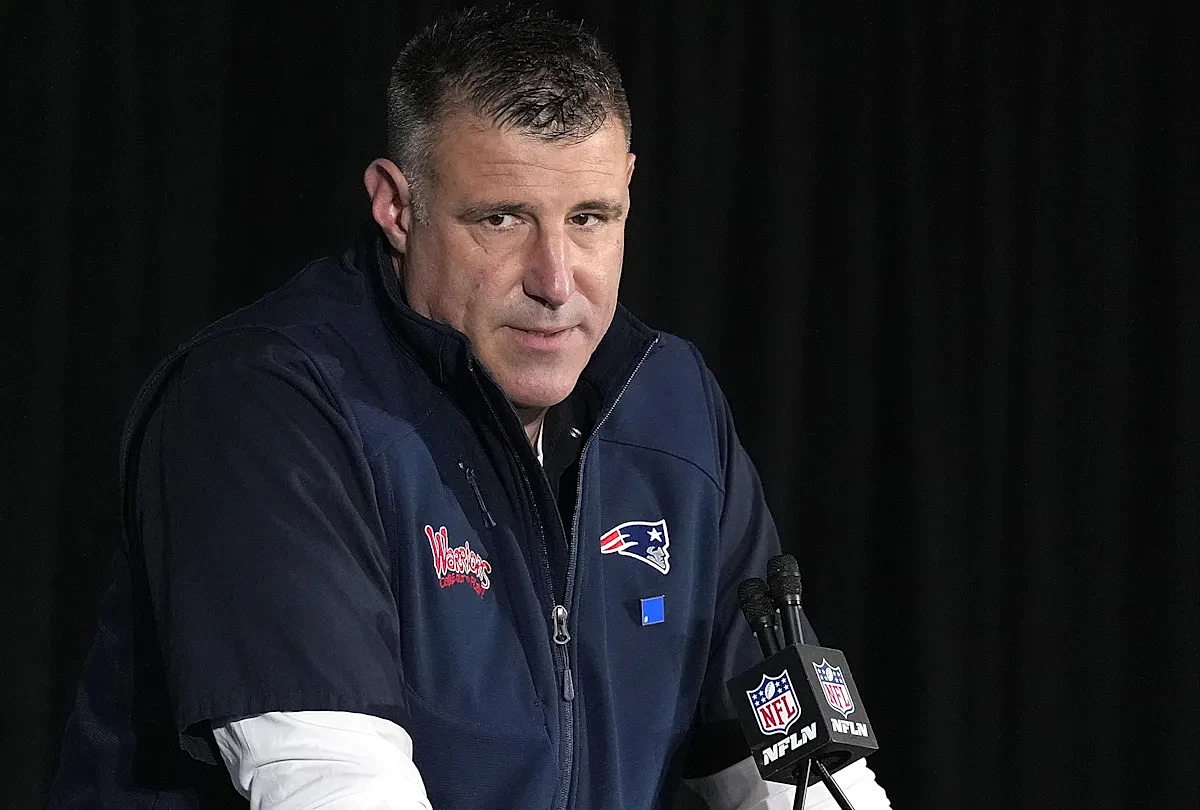


The NFL offseason ebbs and flows, and after a few relatively quiet weeks a big one awaits. On Thursday, the 2026 draft will kick off in Pittsburgh, and it will be an opportunity for the New England Patriots to add to a roster that already won them a division title and earned them a Super Bowl berth last season.
Naturally, our focus will mostly be on the draft in the coming days. It is therefore also no surprise that this week’s Sunday Patriots Notes are heavy on draft talk. Enjoy.
Speaking in the simplest of terms, NFL teams operate in two spheres when it comes to making decisions in the draft: they either draft for need or go with the best player on the board regardless of position. While the second approach is definitely preferred, as head coach Mike Vrabel made quite clear earlier this offseason, the Patriots cannot make these decisions in a vacuum either.
Executive vice president of player personnel Eliot Wolf pointed this out during his pre-draft press conference at Gillette Stadium this week.
“I think it’s easy to look at a piece of paper or a depth chart right now and just kind of see what our needs are right this second, but you also have to factor in who’s going to be a free agent next year because this isn’t just a one-year filler. This is a long-term commitment, especially with the early-round guys that you think are going to be there,” Wolf explained.
“So, I like to look at it more along the lines of what don’t we need? Because there’s a lot less of that when you look at it that way. Center is always a good one. If you have two really good centers, you’re not going to draft a third center. Everything has to work together. So, I think about it as, what can we eliminate from consideration? Especially when you’re picking down at 31 and at the end of these rounds, it’s a little bit harder to predict exactly who’s going to be there. So, you just have to make sure that you’re going to pick a good football player at any point.”
Wolf’s bottom-up approach to identifying draft targets creates an interesting dynamic, because it also shows how the team feels about its current roster at the moment a pick is made.
Staying along the interior offensive line, the Patriots have all three starters — Alijah Vera-Tucker, Jared Wilson, Mike Onwenu — as well as top backup Ben Brown under contract for multiple years. From that perspective, no investments are needed. However, Vera-Tucker has an extensive injury history and Onwenu is set to enter free agency next March, meaning that guard might just be on the draft wish list.
If the Patriots come out of the draft without any interior linemen added, though, it can be interpreted as a vote of confidence in the current personnel. At least if we apply Wolf’s “eliminating what we don’t need” strategy.
The window for NFL teams to host draft prospects at their own facility closed earlier this week, and so far we know of 24 so-called 30 visits as well as a pair of local ones for the Patriots. While they are not permitted to work players out on the field during those sessions, they are still a valuable tool for the club.
“It’s very important,” said Wolf. “We bring guys in for a variety of reasons, whether it’s to get medical, to get them in front of Mike [Vrabel]. If it’s a guy we like that doesn’t have a lot of red flags, we’re like, ‘Hey, Mike’s going to love this guy.’ We do some of that.
“Then if there are some questions about the character, their learning, the position fit or again, like one that I mentioned earlier, we think this guy is definitely going to be able to play X-receiver, but we want to bring him in and make sure that we think he can play multiple spots and how early could that be. So, there’s a variety of reasons that we bring guys in. They’ve been great this year. We haven’t eliminated anyone, as we’ve done in the past. So, it’s been positive.”
Last year, the Patriots hosted six of their eventual 11 selections at Gillette Stadium leading up to the draft.
As with the draft itself, flexibility also is a key component of the meetings process. For the Patriots, this means adjusting plans on the fly — something that happened with two prospects targeted for 30 visits.
Florida edge rusher George Gumbs Jr. was scheduled to visit Foxborough last week, but the meeting was ultimately cancelled by the team. Meanwhile, it wanted to bring Texas A&M guard Chase Bisontis in but a scheduling conflict prevented that meeting from ever happening.
The Patriots are the owners of the 31st pick in the draft, but them making a selection in that spot is not guaranteed. Depending on the board, some movement might up or down might happen; Eliot Wolf and his team do not seem averse to giving up that selection or other assets in pursuit of their targets.
In general, trading is commonplace on draft weekend, and the Patriots making at least one move is highly likely. They have done so in every draft since 1999.
This year, there are several potential areas to look at regardless of what happens in Round 1. For example, they have five selections between the 191st and 224th picks on Day 3, and all of those selections being made is not expected to happen. They also are on the clock 125th and 131st overall in the fourth round, meaning that one of those selections also could be used to manipulate the board.
One thing to keep in mind, though: since taking over as the Patriots’ quasi-general manager in January 2024, Eliot Wolf has never traded away a draft pick to acquire a player directly.
Even though Eliot Wolf and the scouting department — including VP of player personnel Ryan Cowden, college scouting director Tony Kinkela and his assistant Matt Evans, senior personnel executive Alonzo Highsmith, VP of football administration Matt Groh and research director Richard Miller — are spearheading the Patriots’ draft efforts, their coaching staff also is involved. Whether that be assistants attending visits or taking to the road or Mike Vrabel himself getting involved, the entire process is multilayered.