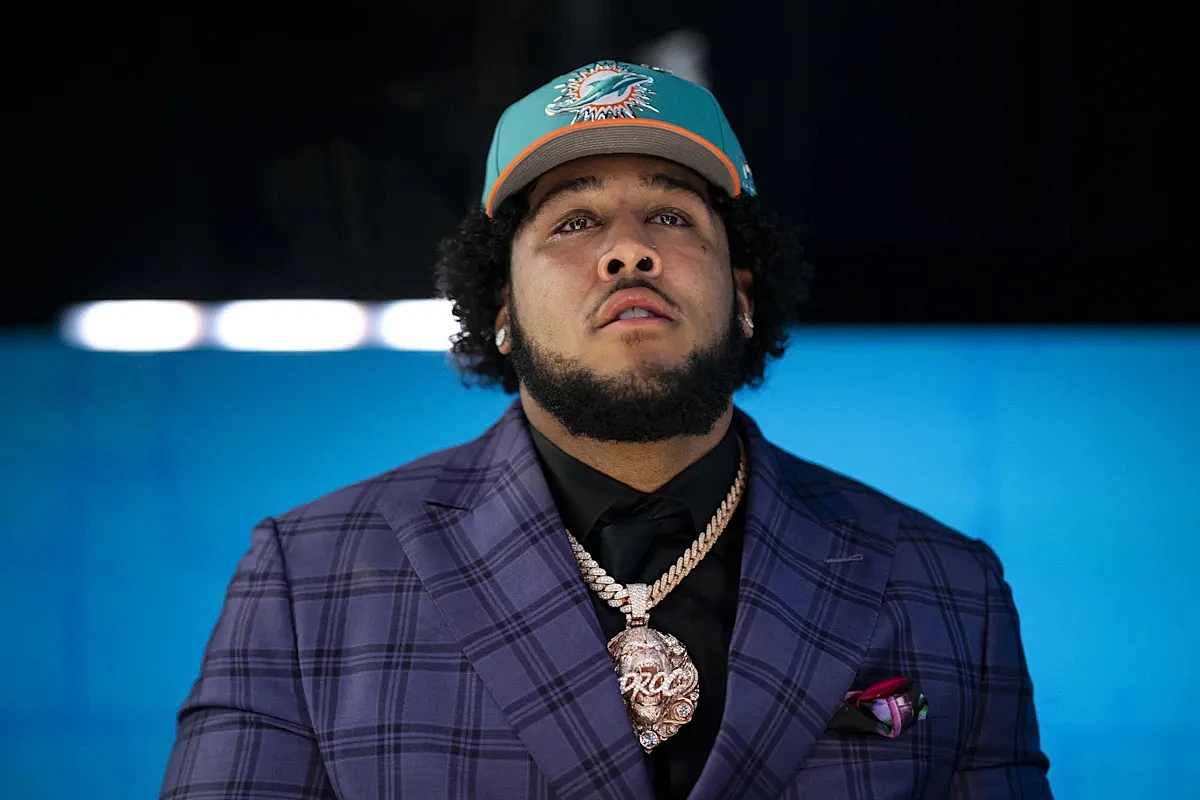


The Miami Dolphins made 13 picks during the 2026 NFL Draft, the most of any team during the three-day selection meeting. It was a busy weekend, with the team making multiple trades up and down the draft order and selecting players who will fit the team’s identity under new general manager Jon-Eric Sullivan and new head coach Jeff Hafley.
How did the Dolphins grade out after all seven rounds of the 2026 Draft were complete? Time to take a look around the web to see the various reactions.
The Dolphins first traded down, surrendering the chance to draft star safety Caleb Downs at No. 11 in exchange for two fifth-round picks from the Cowboys, then added Proctor’s massive build and strength to the offensive line with the 12th overall choice. Next, the Dolphins traded up, sending San Francisco the first-round pick gained from dealing Jaylen Waddle to Denver for the chance to select Johnson, one of my favorite defenders in the draft due to his speed, smooth movement and ball skills. Miami added Rodriguez, an ultra-athletic gamer and the best player available, at No. 43, then grabbed two receivers in the third round: Douglas, a downfield threat, and Bell, an A.J. Brown-type receiver coming off a knee injury.
Moore moved from the edge at UTSA to the second level with Texas, raising questions about how his size and length might translate, but Miami picked him as an edge over several other worthy prospects. Louis and Taaffe will be effective nickel defenders at linebacker and safety and should provide special teams help, as well. Traore’s move from England to the U.S. to play football is a great story, but his athleticism is what will help Miami’s tight end depth chart.
Top needs entering the draft: Wide receiver, edge rusher, cornerback, right tackle, safety
I ran out of room adding needs to my list. This roster needed everything. Everything. And as such, no one really knew which of their weak positions they’d hit at No. 11 and No. 30. Of course, the latter pick came over from Denver when the Dolphins traded Jaylen Waddle. Coupled with releasing Tyreek Hill, that pushed WR to the top of the needs list.
Neither of those first-rounders went that direction, which might cause some problems for new quarterback Malik Willis. But Miami added Kadyn Proctor at No. 12 after a one-slot trade back netted two fifth-rounders. He has the experience (40 starts) and quickness out of his set to handle the right tackle position. Incumbent Austin Jackson missed 11 games last season, and Larry Borom left in free agency. The Dolphins had to do something there, and Proctor has been a buzzy name over the past two months. He played exclusively left tackle at Alabama, but I’m confident he can flip to the right side based on the agility I see on tape. Proctor might not be catching passes for Willis like a receiver at 11 would have — or maybe he will? — but he’s going to help the Dolphins’ new quarterback even so.
The next pick came after a slight trade up, moving up three spots to No. 27 at the cost of moving from No. 90 to No. 138 later in the draft. With 13 picks on hand at that point in the draft, that’s 100 percent worth it — especially to land Chris Johnson, who I bumped up to CB3 in the class. The Dolphins’ cornerback room was in shambles, and Johnson immediately brings his ball skills (six interceptions and 16 pass breakups over the past three seasons) to the starting lineup.
But what about receiver? Caleb Douglas was a reach (No. 148 overall going 75th) and Chris Bell is coming off a torn ACL. Granted, Bell has first-round level talent when healthy, and he can produce over the middle, downfield and after the catch. But I didn’t see enough done to the WR room. Malik Washington and Jalen Tolbert are still the WR1 and WR2 on this roster, respectively. That’s an issue.
I’m a big fan of Jacob Rodriguez, and Kyle Louis is a baller who will line up all over the place and make plays. Miami ultimately made 13 picks, and a lot of these players are going to see the field in 2026, whether they’re ready or not.
Best Pick: Second-round linebacker Jacob Rodriguez from Texas Tech will prove to be a big-time player on their defense. He has the ball instincts you love for the position.
Worst Pick: Third-round tight end Will Kacmarek is a good blocker, not a great one, but is limited in terms of his receiving skills.
The Skinny: Jon-Eric Sullivan had a heck of a draft. I loved the pick of tackle/guard Kadyn Proctor in the first round. They then loaded up on a bunch of good players with their remaining picks. Receiver Caleb Douglas will prove to be a steal.
R1 (12) Kadyn Proctor — OT, Alabama A+R1 (27) Chris Johnson — CB, San Diego State AR2 (43) Jacob Rodriguez — LB, Texas Tech AR3 (75) Caleb Douglas — WR, Texas Tech D+R3 (87) Will Kacmarek — TE, Ohio State BR3 (94) Chris Bell — WR, Louisville A-R4 (130) Trey Moore — EDGE, Texas BR4 (138) Kyle Louis — LB, Pittsburgh B-R5 (158) Michael Taaffe — S, Texas BR5 (177) Kevin Coleman Jr. — WR, Missouri BR5 (180) Seydou Traore — TE, Mississippi State B-R6 (200) DJ Campbell — IOL, Texas B-R7 (238) Max Llewellyn — EDGE, Iowa A-
Miami had needs across the board heading into the draft, which afforded it the ability to take the best player available with each selection. That’s one of the perks of being squarely entrenched in a rebuild.
The Dolphins signed what might be their franchise quarterback in Malik Willis in free agency, and now they have more protection for him in the form of Kadyn Proctor. He was a polarizing prospect in the pre-draft process because of his size — a major asset that could also limit him if he isn’t able to play at a manageable weight. If Miami gets the best version of him, he can stick at left tackle and become a building block of this rebuild.
On defense, Chris Johnson could be a lockdown corner for years to come, while Jacob Rodriguez was the best defensive player in college football last year. That’s a pretty exciting pair of players.
The only whiff of Miami’s draft came in Round 3 with the Caleb Douglas pick. Renner called it “one of the biggest reaches of the draft so far, not only on my board, but also on the consensus board where he was outside the top-200.”
With an NFL-high 13 draft picks used, no team was better positioned to make a splash in the 2026 draft than the Miami Dolphins — but I’m not convinced this class will prove much better than a belly flop. Don’t get me wrong, there are some prospects added that I think are going to be quality NFL players. Specifically, I love the selections of cornerback Chris Johnson, wideout Chris Bell and linebacker Kyle Louis, and I like the additions of Jacob Rodriguez and Kevin Coleman, as well. But the Dolphins started off the class with, literally and figuratively, one of the “biggest” gambles of the draft in Alabama’s Kadyn Proctor. There are teams that could afford such a roll of the dice, but I don’t believe the Dolphins are one of them. Similarly, while I like Texas Tech wideout Caleb Douglas, I don’t see him as a future No. 1 wideout in the NFL or, frankly, appreciably better than the two pass-catchers GM Jon-Eric Sullivan nabbed later in Bell and Coleman. The Dolphins are in the midst of a complete roster rebuild, so I have no doubt that most of these players will make the team. But will Miami be one that wins more than a handful of games next year? I have my doubts.
No team needed more help in the draft than Miami, and the Dolphins addressed multiple areas of need. Proctor, Johnson, Rodriguez and Douglas are all potential starters as rookies. Bell is the ultimate boom-or-bust pick, as he’s coming off a torn ACL but has explosive talent, evidenced by his 917 yards and six scores in 2025. The big question is whether Proctor works out, as he struggled with weight issues throughout college. Ultimately, the Dolphins took 13 players, including five pass catchers to help Malik Willis.