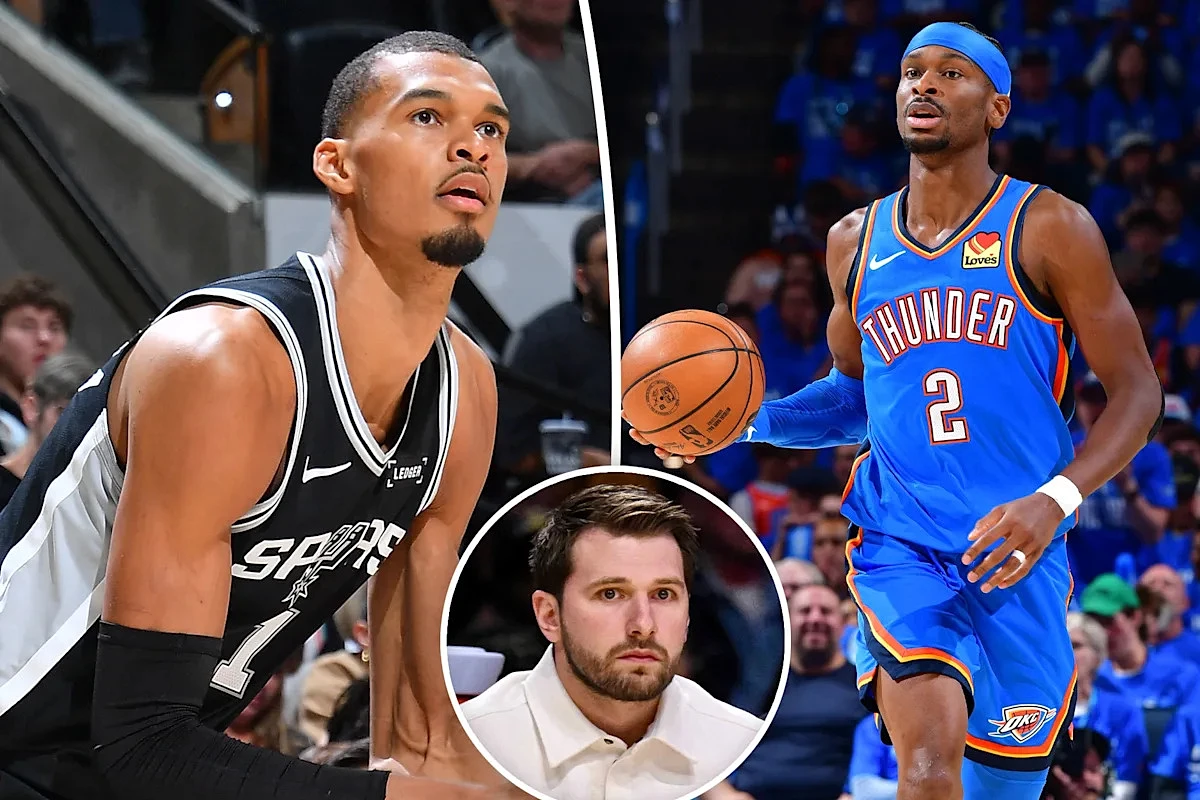


There’s a difference between being snubbed…and inconvenience.
The fact that Lakers superstar Luka Doncic missed out on being named an NBA MVP finalist falls into that category. He was the inconvenience that voters didn’t quite know how to handle. Because his historic season doesn’t fit neatly into the box they’ve spent years building.
Was that the right decision? We can make the argument either way, but perhaps there’s a solution at the end of all this that can appease everyone.
Let’s start with the finalists: Shai Gilgeous-Alexander, Victor Wembanyama, and Nikola Jokic.
All three are deserving. They all play on the No. 1, No, 2, and No. 3 seeds in the Western Conference. They are all the best players on their own team with elite level production on both ends of the floor. They check all the boxes.
But MVP isn’t supposed to be an exercise performed with a Sharpie and a checklist. There’s more gravitas to it. There’s the eye test. There’s the feeling in your gut when you know you’re seeing one of the best players in the world do what they do best. There’s how opposing defenses throw the kitchen sink at one player just to try and slow him down only to discover they can’t.
And nobody made us feel that way this season quite like Doncic.
He led the league in scoring at 33.5 points per game. More than 2.4 points more than SGA. Pair that with 8.3 assists, 7.7 rebounds and over 100 steals. Night after night, Doncic wasn’t just producing. He was dominating. No player in NBA history has ever averaged 30+ points, 7+ assists, and 7 + rebounds on a team that won 50 games or more and not won the MVP. Doncic will have now done it twice (2024).
And let’s not forget that he had to carry the Lakers on his back for most of the season.
The Lakers takeoff this season did not come with a clean runway. There was turbulence on the tarmac. An early sciatica injury to LeBron James saw him miss the first 14 games of the season. Doncic led them to a 10-4 record. Midway through the season their second leading scorer Austin Reaves went down with an injury. So did other role players. The Lakers roster felt like it was constantly being rearranged mid-flight. But through it all, Doncic was the pilot that guided them through the turbulence.
So when his teammates that were on this journey with him were asked their thoughts on Doncic not being an MVP finalist they didn’t hesitate with their answers.
“You can see he’s the MVP,” said Lakers’ forward Rui Hachimura. “I can see he’s the MVP of this league. What he does, what he brings to the game every game.”
But unfortunately, analytics and advanced metrics is where the divide and the case against Doncic begins.
The anti-Doncic crowd will point to his plus-4 net rating. They’ll stack that next to Jokic’s plus-10.4, SGA’s plus-14.8, and Wemby’s gaudy plus-17.3 and call it decisive. They’ll bring up the defensive metrics as well, where admittedly, Doncic lags behind. They’ll remind you, correctly, that the other finalists are all two-way players, including Wemby who at 22 years old just became the youngest and first ever unanimous player ever to win the Defensive Player of the Year award.
But when did the MVP award become less about overall value to a team and more about the completeness of an individual player?
Not since Russell Westbrook in the 2014-15 season has a player ever led the league in scoring and not finished as a top three MVP finalist.
Doncic’s MVP campaign is messy. He’s ball-dominant. He’s emotional and racks up technical fouls like dishes. He’s defensively inconsistent. He doesn’t check every box.
And yet, in the month of March, Doncic dominated the entire league. The Lakers went 16-2 over an 18-game stretch. Doncic was the undisputed Player of the Month, breaking Kobe Bryant’s franchise record, and finishing second only to Michael Jordan with 600 points. His MVP odds surged. He went from out of the race, to second behind SGA by March 31.
“If we continue to finish the season the way we’re playing right now, and he continues to play that way — to me, he is the MVP,” said Lakers’ head coach J.J. Redick at the time.
“The better I play, the more I go down in ratings,” he said in Spanish, half-joking, fully aware of the dialogue going on in the sports talk world.