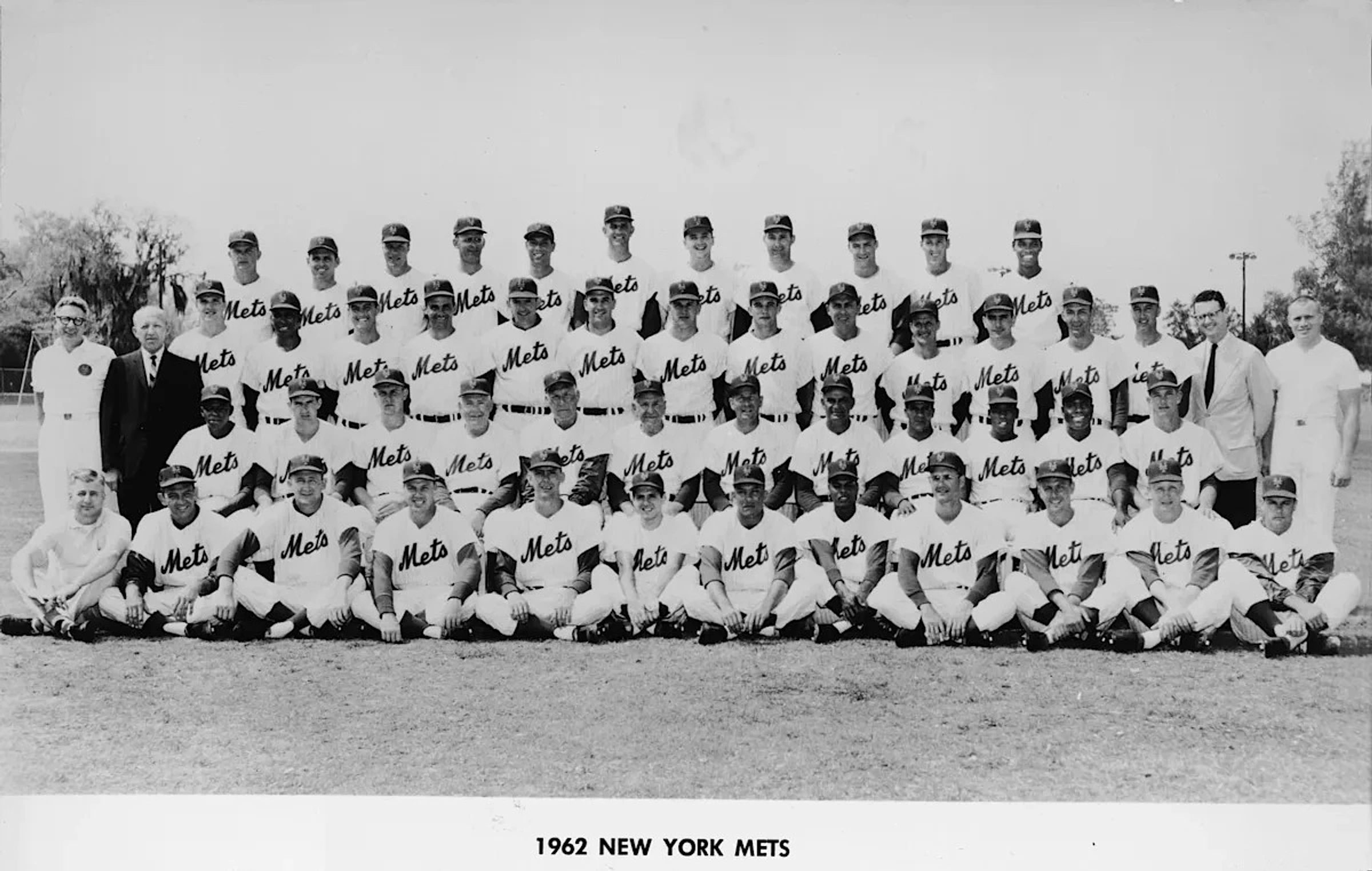


For much of Mets history, fans have been able to find some solace amid their misery in a simple notion: At least it’s not as bad as 1962. With the 2026 Mets mired in an 11-game losing streak, now would seem the perfect time to cue that sentiment once again.
The 1962 Mets managed to lose at least 11 consecutive games on three separate occasions en route to a 40-120 record, the third-worst win percentage (.250) of any AL/NL team in the modern era behind the 1916 Athletics (.235) and 1935 Braves (.248). The Mets even began the season on a nine-game losing streak. But after that horrific start, they actually managed to go 12-10 over their next 22 games. On May 21, they had won 9 of their last 12 games, including four walk-offs at the Polo Grounds, moving all the way up to eighth place out of ten teams in the National League.
That’s when the wheels came off. They would never see the likes of eighth place again, and soon ninth place would be permanently out of reach as well, as the 1962 Mets were about to begin a breathtakingly baffling 17-game losing streak — the longest in franchise history, and the subject of this long-deserved, game-by-game retrospective. However absurd, miserable, and outright hilarious you might think this seventeen-game losing streak was: think bigger.
It involved a curse on eighth innings, a run-in with Calvin Coolidge (not that one), a brawl with a pair of Hall of Famers, a homestand of emotional reunions at the Polo Grounds, a forgotten hitting streak, and the dramatic redemption of possibly the worst pitcher in Mets history. So without further ado, let us travel back to May 21, 1962, taking a whimsical journey through baseball history to witness what is actually, indisputably, still the feeblest stretch of New York Mets baseball….
The Mets made their first-ever trip to Houston to face a fellow rookie franchise in the Colt .45s, who at this point were 1.5 games behind the Mets in the NL standings.
Believe it or not, the first game of this unfortunate streak began as the snapping of a positive one, as the Mets entered looking to extend their budding three-game win streak. They even took an early 2-0 lead (the ’26 Mets are still yet to maintain a two-run lead at any point during their losing streak) against Houston starter Jim Golden, but were shut out the rest of the way in one of Golden’s five career complete games. Golden would go on to win only seven games during the 1962 season; five of them came against the Mets.
Relief pitcher and future U.S. congressman Vinegar Bend Mizell, nicknamed for a town in Alabama near his native Leakessville, Mississippi, was pinned with a hard-luck loss for the Mets despite turning in 5.1 innings of one-run ball in relief. The game was tied at 2-2 until the bottom of the eighth (an inning which would soon come to be synonymous with terror for the Mets), when Houston’s 38-year-old Jim Pendleton knocked a pinch-hit triple off the left-center-field wall and was promptly brought home on a sac fly. The Mets threatened in the ninth thanks to hits from Sammy Taylor and All-Star Richie Ashburn, but could not tie it.
Jay Hook, owner of the first win in Mets history the previous month, took the ball for a nighttime getaway game in Houston. Hook went eight strong, surrendering a game-tying solo shot to Román Mejías — the right fielder who delivered the sac-fly the day prior — and nothing else until the eighth inning, when the Colt .45s rallied for two.
Houston starter Turk Furrell, who would go on to put up 7.0 bWAR that season despite going just 10-20 with a 3.02 ERA in 241.2 innings pitched, worked around trouble. The Mets mustered ten hits but just two runs. A promising rally seemed to be building in the ninth inning when they got two on with nobody out while trailing by two, but Sammy Taylor flew out and the pitcher Hook (who was not pinch-hit for in this situation, probably making Casey Stengel delighted there was no Twitter at the time) struck out. The Mets’ lone All-Star Ashburn once again came through late, hitting an RBI single to make it a 3-2 ballgame, but an Elio Chacón grounder ended it.
The Mets were now bound for the West Coast to face their New York forefathers, the Dodgers and Giants, for the first time. The flight from Houston to Los Angeles was scheduled to arrive at about 5:45am, though Roger Craig, the next day’s starting pitcher and the ‘62 team’s de facto ace, had already made the trip.
The first-ever contest between the Mets and Dodgers was, fittingly, a pitchers’ duel, as Roger Craig and NL Cy Young winner Don Drysdale kept things locked at a 1-1 tie until the eighth. The Dodgers got on the board in the third thanks to NL MVP Maury Wills, who hit a one-out single just out of the reach of a diving Richie Ashburn and drew enough attention at first to cause a balk from Craig after multiple pickoff attempts.
The Mets got on the board with an RBI single the following inning from right fielder Joe Christopher, who had been promoted from Syracuse two days earlier (meaning his first game with the Mets unfortunately aligned with the start of the losing streak). The next batter, Frank Thomas, nearly put the Mets ahead with a deep fly ball to left field, but the Dodgers’ Tommy Davis caught it before it could land in the sparkling new Dodger Stadium seats.
The Dodgers finally got to Craig in the eighth, of course, scoring a pair. Meanwhile, Drysdale was impenetrable, retiring nine of the last ten Mets to complete a dominant four-hitter. Speaking of streaks, the game began a stretch lasting through early August in which Drysdale went 16-1.
The Mets’ defense got off to a hot start in this one, with Wills shockingly being caught stealing by Mets catcher Harry Chiti before Tommy Davis was robbed of a hit in right. The game then became a battle of the Franks, with the Dodgers’ Frank Howard and Mets’ Frank Thomas trading early homers. The Mets were up 2-1 until an error by second baseman and former Dodger Charlie Neal set up an L.A. run in the seventh, and the familiarly stubborn eighth inning yielded two more. For four consecutive games, the Mets had surrendered the go-ahead run in the eighth.
Aside from Thomas’ homer, the Mets couldn’t get anything going against Johnny Podres — the man on the mound for 1955 World Series MVP who was on the mound when Dem Bums finally won a championship — and were four-hit for the second straight day.
With the loss, the Mets were now relegated to last place in the National League. It was a slot in the standings they would never escape.
Unlike their previous four losses, this one wasn’t a tight, low-scoring affair decided by a late rally or defensive miscue. The Dodgers barraged the Mets for 17 runs on 18 hits, tying a record for the most runs the Dodgers had scored since moving to Los Angeles four years prior.
To add insult to injury, the Mets’ offense actually put up a valiant effort, scoring eight runs off 19-year-old Dodger rookie Joe Moeller. It was the only game during the 17-game losing streak in which they would score more than six runs, and yet they still somehow lost by nine. Frank Thomas hit another home run for New York, while third baseman Cliff Cook — who had been traded to the Mets from Cincinnati as part of a package for veteran third baseman and baseball legend Don Zimmer — notched his first Mets homer.
The Mets also got the first four-hit day in franchise history from Félix Mantilla, who somehow accomplished the feat despite only entering the game in the third inning after starting shortstop Elio Chacón was ejected. But this one was all Dodgers, leaving the Mets searching for answers as they departed north for San Francisco.
It seemed the Mets might finally pull one out, leading 5-4 with only six outs to get. But that pesky eighth inning struck again, as the scorching hot Willie Mays — coming off three homers in his prior two games — drilled a solo homer off the Mets’ starter Jay Hook. Just like that, the first Mets-Giants contest was going to extra innings.