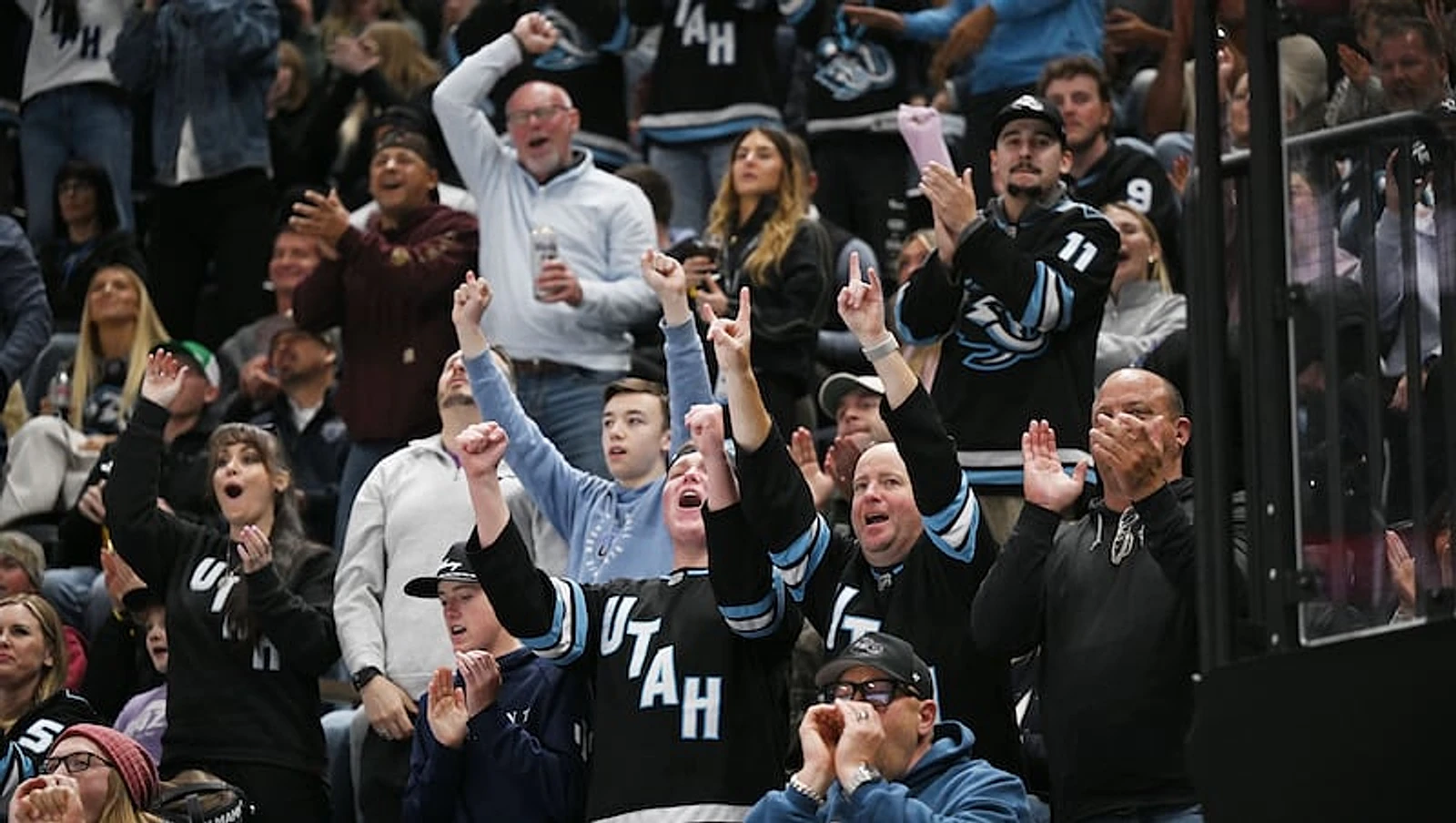

Minutes after the Utah Mammoth’s penultimate game of the regular season concluded Tuesday, fans flooded onto the Delta Center ice.
It’s not like a football, basketball or soccer game, where security guards are the lone barrier between the stars and the public — even NHL players sometimes have a hard time opening the solid, heavy gates that surround the ice surface.
But in this instance, and for the first time ever, team officials encouraged fans to come down and decorate the ice with messages of support to the team ahead of its first-ever playoff run.
It was a scene that Mammoth season ticket holder and lifelong hockey fan Jerry VanIeperen never thought possible just a few years ago.
“I never imagined an NHL team would be in Salt Lake,” he told the Deseret News. “I was hoping (to get the) AHL at some point again. It’s just been so fun.”
VanIeperen remembers walking his dogs in his Calgary Flames jersey, knowing most passersby had no idea what he was representing.
Now, he and his wife, Marcie, have found an entirely new friend group as they attend Mammoth games and other events.
For every lifelong hockey fan like Jerry, there are several new hockey fans like Sean Gillan and Colin Lloyd, who spoke to the Deseret News on the ice at the painting event.
“We both became hockey fans because of the Mammoth,” Gillan explained.
They’ve benefited from a number of the Mammoth’s programs that are designed for the purpose of getting new fans invested in the game. They frequently use the Smith’s grocery store $15 ticket program, for example.
“It’s always kind of been in the background that I’d like hockey, but I never had a team, you know? ... Having something that’s local and that’s constantly there for you, it changes everything,” Lloyd said.
Getting to this point with both the team and the fan base has been years in the making.
The NHL might have the most tedious rebuilds in all of sports.
Virtually every team that has achieved long-term success has had not just one, but several highly drafted players. Teams seldom trade those picks, so you have to earn them through bad seasons of hockey.
Even then, there are no guarantees. Look at the Buffalo Sabres.
There are teenagers with learner’s permits who have never been alive for a Sabres playoff game. They’ve had two first-overall and two second-overall picks since then, and they’ve finally made the playoffs this year.
The Arizona Coyotes were in that same boat the bulk of their existence. No matter how much losing they did, they could never seem to assemble enough top talents to sustain any success.
One year removed from his Stanley Cup championship as an assistant GM with the St. Louis Blues, Armstrong went to Arizona with a plan.
The first step was to take on bad contracts in exchange for draft picks. The flat salary cap during the pandemic seasons put cap space at a premium, which increased the haul the Coyotes could get in each trade.
Next, they had to use those draft picks the right way. Armstrong brought in Darryl Plandowski and Ryan Jankowski to lead the scouting department. A number of others, including head coach André Tourigny, came in to help develop the young players.