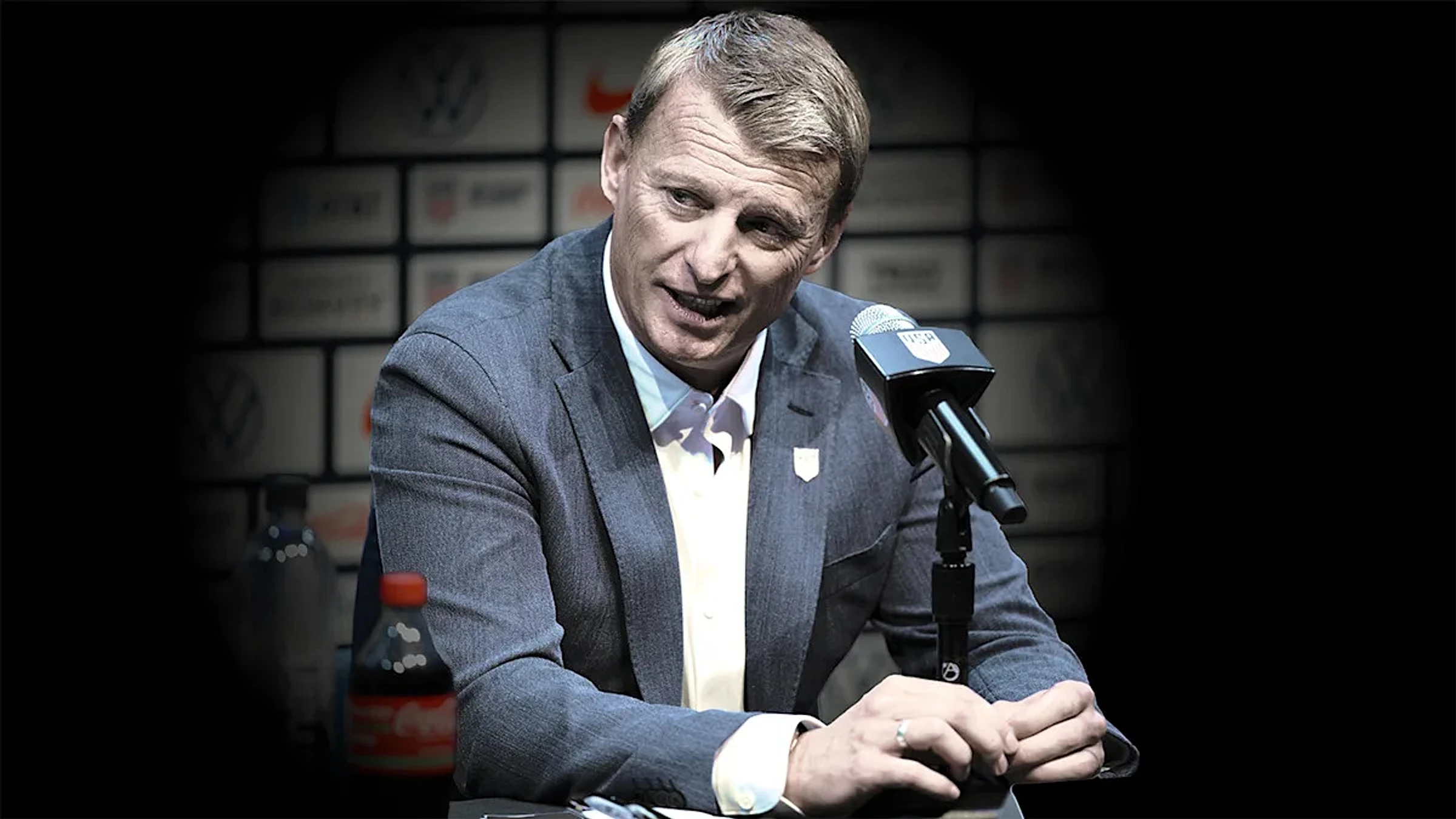


The departure of Matt Crocker on the doorstep of the 2026 FIFA World Cup leaves a sour taste for U.S. Soccer, which must now begin planning for life beyond 2026.
In a sudden move, Matt Crocker is out as U.S. Soccer’s sporting director just two months before the United States is set to face Paraguay in its 2026 World Cup opener. When it comes to the day-to-day operations of an already shaky United States men’s national team, not much changes. Mauricio Pochettino remains in charge of a group that has historically underdelivered, with one final opportunity to salvage its legacy: the World Cup.
On the women’s side, Emma Hayes, arguably Crocker’s most important and influential hire, continues to lead the United States women’s national team through what looks like a genuine renaissance. Her impact may leave lasting foundations for the women’s game long after her tenure ends.
As for Crocker, who is reportedly set to take on a similar role with the Saudi Arabian federation, much of his work feels unfinished. To the average USMNT fan, his tenure will ultimately be judged by the team’s performance at the 2026 World Cup. But for those who understand the scope of his role, his departure leaves yet another gap in a federation that has long struggled to establish a clear ideology and path for soccer in its own country, one that must begin at the youth level.
So what exactly did Matt Crocker do? It’s a question many have struggled to answer.
At a macro level, Crocker appointed two USMNT head coaches and one USWNT coach, with mixed results. The rehiring of Gregg Berhalter remains a puzzling decision three years later. At the time, Crocker was just a few months into the job, and instead of making a bold hire that would set the tone for his tenure, he stuck to the status quo that was seemingly thrust upon him by the U.S. Soccer higher ups. In hindsight, it proved to be a mistake.
Crocker attempted to correct course by hiring Pochettino, but results on the men’s side have largely remained disappointing, including underwhelming performances in the CONCACAF Gold Cup and CONCACAF Nations League, which by U.S. standards can be seen as failures.
On the women’s side, however, the appointment of Hayes was widely seen as a no-brainer. One of the most respected coaches in the game, she has already expanded the player pool and delivered an Olympic gold medal. One year out of the 2027 Women’s World Cup, and the USWNT couldn’t be in a more inverse place than the men’s team was at this point last year.
At the youth level, Crocker can point to some positives. The U.S. reached the quarterfinals of the FIFA U-20 World Cup, and Benjamin Cremaschi finished as the tournament’s top scorer. The team also recorded notable wins against traditional powerhouses France and Italy, before falling to rising Morocco.
Off the field, Crocker introduced a sweeping development initiative known as the “U.S. Way,” aimed at reshaping how soccer is taught and played across the country. The plan seeks to unify a fragmented system by aligning youth academies with senior national teams, prioritizing long-term player development over short-term results. By standardizing coaching methods and incorporating advanced data analysis, the federation hopes to create a clear identity and a more efficient pathway for developing talent.
The strategy also includes major investment in infrastructure, highlighted by a new national training center in Georgia, while attempting to address long-standing barriers such as the pay-to-play model.
Former USMNT player and former U.S. Soccer youth director Tab Ramos told Urban Pitch that while Crocker laid important groundwork, implementing a unified vision within U.S. Soccer is far from simple.
“The sporting director role is much bigger than just the national teams,” Ramos said. “Once the hires that match your vision are made, it becomes a matter of ensuring everything continues moving forward. More importantly, it’s about defining what all of soccer should look like and then building a strategy that convinces all stakeholders to work toward a common goal, especially in a country without a strong soccer culture. The U.S. is huge, and it can take many years to fully understand the politics within the game.”
Still, skepticism remains. Some former national team players question whether a system increasingly driven by data analytics risks losing the human element of the game and the simplicity of the sport itself.
Ultimately, Crocker will not be around to see whether his decisions, including his coaching hires and the “U.S. Way,” will pay off, or if they will join a long list of ambitious projects that failed to produce meaningful change.
For the past eight years, U.S. Soccer has operated in something of a bubble, fueled by the anticipation of the 2026 World Cup, the emergence of a so-called “golden generation,” and the growth of Major League Soccer. But cracks in the system are becoming increasingly visible.
The World Cup itself has drawn criticism over soaring ticket prices and what many see as a lack of intervention from U.S. Soccer. Meanwhile, the men’s “golden generation” has delivered underwhelming results for the better part of six years, leaving fan morale at a low point. MLS, despite the boost from Lionel Messi, still faces questions about its long-term trajectory once the Argentine leaves the league.
What’s needed now is a reality check. The United States is not yet a global soccer power and, in some respects, lags behind emerging nations like Morocco, who have a thriving national team and solid youth teams.
When the 2026 bubble bursts, the search for a new sporting director presents a rare opportunity to unify the game in the United States rather than continue its fragmentation.
The next sporting director must recognize that while the federation can set guidelines, development ultimately happens at the club and youth level. Flexibility will be key. Some programs may lean on data, while others on technical development, but all must contribute to a coherent national vision.