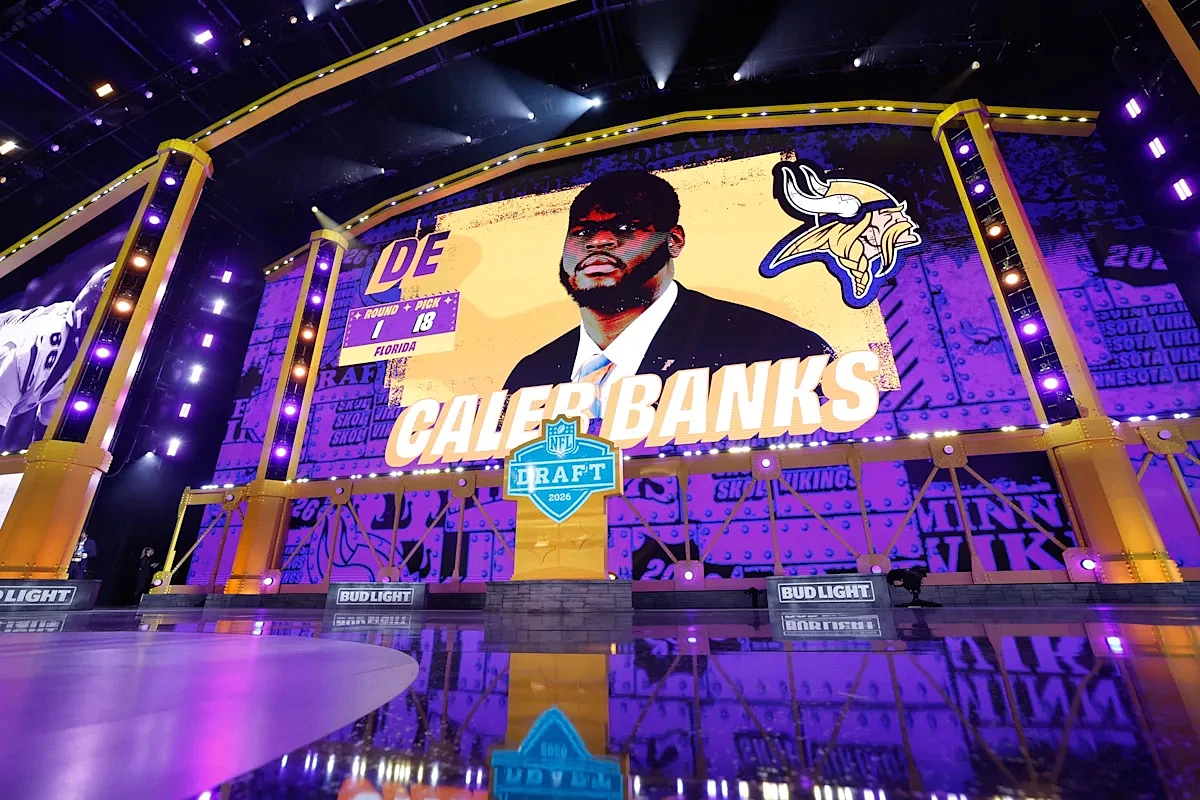


The Minnesota Vikings concluded an eventful three days of the NFL Draft that included a few trades, including Jonathan Greenard, the drafting of nine players, and the signing of 19 undrafted free agents.
It was largely a defensive draft for the Vikings, with the first three picks going for defensive players and four of the first five. And while that emphasis corresponded with the Vikings’ roster needs, the increased influence of newly extended defensive coordinator Brian Flores could be felt. The results also provide some insight on how the coaching staff view their existing roster, and a little into their drafting process and roster priorities.
This off-season has seen the elevation of Brian Flores in terms of influence within the Vikings organization. The Vikings were eager to extend his contract, but Flores allowed it to lapse as he considered any head coaching opportunities. But in January he also expressed a lack of confidence in the direction of the front office, meaning general manager Kwesi Adofo-Mensah. That reached ownership in their season-end evaluations in mid-January, with Flores still unsigned, and led to the unusually timed firing of Adofo-Mensah at the end of January after ownership had a chance to review the situation and ultimately decide to part ways with him. The Wilfs hadn’t planned to fire Adofo-Mensah at the end of the season, otherwise they would have done so earlier in January, immediately after the season was over, which is the customary timeframe for such moves. But when Flores raised his dissatisfaction, the Wilfs fired Adofo-Mensah. It wasn’t until after Adofo-Mensah was fired that Brian Flores agreed to an extension that reportedly makes him one of the highest paid coordinators in the league, if not the highest.
Clearly that sequence of events speaks to how well Flores is regarded in the Vikings organization. And it comes after Flores didn’t see eye-to-eye with Assistant Head Coach Mike Pettine last year, which resulted in Pettine switching to the offensive coaching staff (although he had always been a defensive coach) and his retirement after last season. Head coach Kevin O’Connell clearly values Flores’ input and having him as his defensive coordinator as he has always spoken highly of him and pretty much allows him to run the defense his way.
But it is also apparent that Flores, a former scout who still enjoys scouting players, has some of his own ideas about scouting and personnel issues. Ideas that didn’t mesh with Adofo-Mensah’s apparently. And so with Adofo-Mensah’s dismissal, and interim general manager Rob Brzezinski not having a background in player evaluation or scouting, someone had to fill the void. And while some of that may have been filled by O’Connell and the scouting staff, it seems that a lot of it was filled by Flores and his approach. I don’t get the impression that has been an unwelcome development, although it is notable that assistant general managers Ryan Grigson and Demitrius Washington seem to have been sidelined to some degree compared to last year.
Kevin O’Connell’s position has, if anything, become stronger as a figurehead for the franchise central to football-related decision-making, but he seems happy to defer to Flores on decisions related to the defense, including drafting decisions. Rob Brzezinski remains chiefly the salary cap guy, trade and contract negotiator, and consensus builder. He runs the draft, but particularly on the defensive side, it looks like Flores overseas the pre-draft process and really sets the parameters for the players the Vikings draft.
Kwesi Adofo-Mensah was supposed to be the analytics GM, because that was his background. Generally regarding draft picks, including undrafted free agents, that translated into picks that almost always had good or great production as measured by PFF grades. That may or may not have been the metric used internally, but there is remarkable consistency in KAM’s draft picks in that regard.
The other key component in measuring prospects is their physical traits, often summarized by their Relative Athletic Score or RAS. There wasn’t nearly as much consistency with KAM’s picks in that regard. For example, the Vikings’ 2023 class had no players with an RAS of 8.00 or above. In the 2025 class, all draft picks had an RAS above 8.00. Other KAM draft classes had mixed RAS scores.
During the KAM era, the Vikings typically met with top draft picks in a Top 30 visit, but not so much with later round prospects. However, they did use Top 30 visits as a recruiting tool for undrafted free agent prospects with some effectiveness.
There didn’t seem to be any consistency with other factors, such as only drafting Power 4/5 conference players, age, etc. Throughout the KAM era, the mantra of drafting tough, smart prospects with whom football is very important was consistent. Also, after KAM’s first draft, he never took a player with significant known injury risk.
In this first draft of the post-KAM era, the same mantra has continued, but at least based on this first draft, there are some differences.
Both college production (measured by PFF grades) and physical traits (measured by RAS) are important. PFF grades of all drafted players remain good or better and RAS are all at least 7.50.
Overall, this draft class seems to have a more clearly delineated minimum for both production and physical traits than was apparent in the KAM era. There may have been some minimum requirements in the KAM era, but there were either exceptions or a lower threshold in some cases.
The other aspect of the draft process that has at least some visibility from the outside is the use of prospect meetings. All but one of the players the Vikings drafted this year had Top 30 visits with the team. A few were not publicly reported prior to the draft but were subsequently mentioned by the team or player after they were drafted. The Vikings met informally with Caleb Tiernan at the Combine and again at his Pro Day, but he was the only draft pick in 2026 not invited for a Top 30 visit.
The Vikings’ Director of College Scouting Mike Sholiton mentioned during his post-draft press conference that the Vikings used the Top 30 visits to help build consensus within the organization for the pick. Of course most prospects invited for Top 30 visits were not picked, so that could have also helped build consensus not to pick a prospect too.
Another aspect of meeting with players, particularly in more substantial Top 30 visits, is to get a better read on the prospect’s personality, football IQ and ability to process. Brian Flores talks about the ‘want to’ as one of his factors in evaluation prospects. An acceptable prospect for him must have the commitment and determination to put in the work necessary to get better, which is necessary for all college players entering the NFL. Meeting in person can help measure some of these mental aspects.
It’s also a way to guard against Lewis Cine-type busts. There was no way to anticipate either Lewis Cine’s freak injury or his complete bust. Both his college production in the SEC and physical traits were outstanding, and he had no significant injury history. But apart from having his rookie season derailed due to a freak injury (which I think the timing of injury makes it that much more difficult to succeed in the NFL), Cine proved to be something of a loner who didn’t interact much with his teammates. That likely contributed to his not working out with the Vikings or the Eagles (who had a lot of former Georgia defensive players on their roster). The Vikings traded down before selecting Cine and there are no reports that they had a Top 30 visit with him. In future drafts the Vikings had Top 30 visits with at least their top draft picks.
In this draft, the Vikings also drafted a prospect in Caleb Banks with a known injury issue with a fractured foot. The Vikings haven’t drafted a prospect with known injury issues since Andrew Booth Jr., KAM’s second pick who was also a bust. Booth had a quad injury that prevented him from doing predraft workouts, and had a history of sports hernia and knee injuries. Booth was placed on IR in November of 2022 after having started only one game that season and was released after the 2023 season.
Rob Brzezinski said the Vikings’ doctors did their due diligence on Banks’ fractured foot and were not concerned about it. Banks’ doctor also put out a letter to NFL teams indicating that he is on track to be fully cleared for football activities in June. He has no other significant injury history apart from the foot fractures.
While I’ll go into a more detailed assessment of each draft pick in future breakdowns, there are some general insights on the Vikings’ draft picks worth mentioning.