

When the most exciting two minutes in sports get underway in less than two weeks, the focus will rightly be on the horses and jockeys making the 1 ¼ mile run for a spot in history. But the path to Derby Day and to the elusive winner’s circle at Churchill Downs is paved with a series of important decisions and transactions that happen long before the first Saturday in May. There’s a game of careful strategy to be played when it comes to horse racing, and increasingly that game runs through an elite group of trainers whose resumes redefine success in the sport.
The big yearling sales in Lexington and Saratoga are akin to the NFL combine or any major gathering of prospects in a top sport. The big-bucks owner connects with a bloodstock agent who steers your way to a top prospect who might even get to the Kentucky Derby. When you win that horse at auction, you may have spent into the millions. It is an investment, to be sure, and it must be nurtured by the services of only the best horse trainers. In the present day, it’s not just individual big-bucks owners who are buying these horses, but partnerships or conglomerates of moneyed people. Cost is no issue.
That rise of partnerships and conglomerates has led to a generation of “super-trainers,” as some call them. These trainers frequently have as many as 200 horses running in their name, and they are often based at several different racetracks or training centers.
These trainers do not hang a shingle outside their barn that says “super-trainer”. Their statistics speak for themselves. I’ve singled out six trainers for an exploration of exactly how important they are for these owners and the sport. Here’s a breakdown by average annual purse earnings from 2025 back to 2020, and where they ranked annually among North American trainers in those years.
BRAD COX – Average annual purse earnings: $27.5 million National rankings: 1, 3, 1, 4, 1, 2
CHAD BROWN – Average annual purse earnings: $25.1 million National rankings: 3, 1, 4, 1, 3, 4
STEVE ASMUSSEN - Average annual purse earnings: $26.3 million National rankings: 2, 2, 2, 3, 2, 1
TODD PLETCHER - Average annual purse earnings: $21.5 million National rankings: 5, 4, 3, 2, 4, 7
BILL MOTT - Average annual purse earnings: $14.2 million National rankings: 6, 11, 5, 5, 8, 8
MARK CASSE – Average annual purse earnings: 16.5 million National rankings: 4, 5, 6, 7, 6, 6
Of this grouping, the only trainer who did not place in the top seven for all six years was Bill Mott. His slightly lower numbers are explained by the fact that he starts less horses, but trains for absolutely the wealthiest and most elite owners. In the category of earnings per start, he ranks right with Cox, Brown, and Pletcher.
But how have these trainers actually done in the Kentucky Derby? It’s an odd set of results, to be sure.
BRAD COX Of 12 starters, his only winner was Mandaloun, who actually finished second in the race. The horse who was first was Medina Spirit, who several months after the race was disqualified for a drug violation.
TODD PLETCHER The all-time Kentucky Derby record holder with 65 starters. In 2013 he had five horses in the race, and four times he had four horses. It can reasonably be assumed that many of these horses were entered because the owners wanted to have a horse in America’s biggest race, although they might be overmatched. From his record number of starters, Pletcher won in 2010 with Super Saver and 2017 with Always Dreaming. He is 2-for-65.
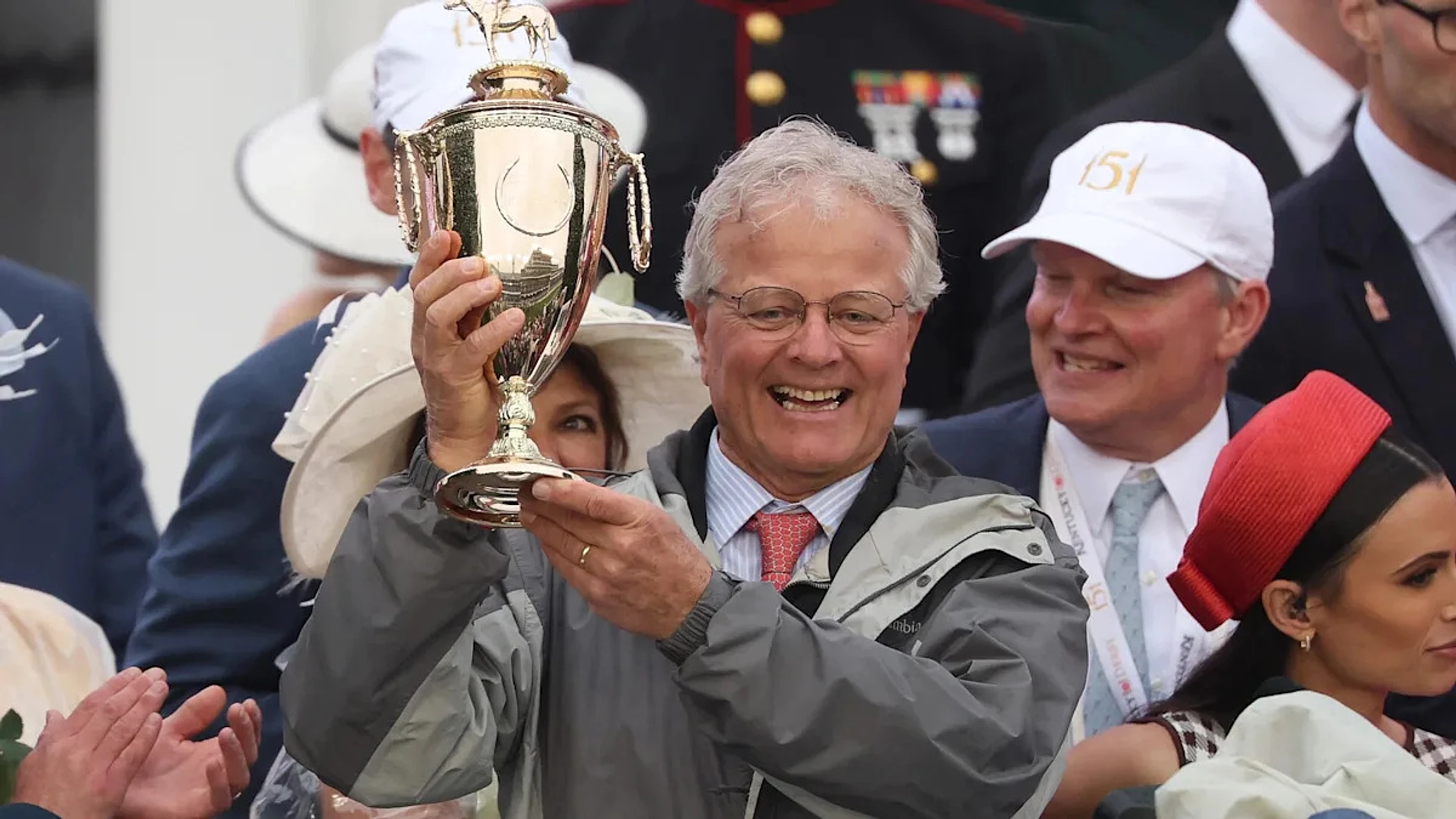
BILL MOTT The youngest trainer ever inducted in the Racing Hall of Fame (at age 45 in 1998), he has also won five Eclipse Awards as the top trainer in the country. His first Derby win came in the unusual case of the disqualification of Maximum Security, who crossed the line first in 2019. On his way, however, he interfered with other horses. Mott’s Country House came up on the outside to finish second. Although he was not interfered with, he was put up for the win. His other Derby win was in the more traditional fashion last year with Sovereignty, who went on to become Horse of the Year.
CHAD BROWN No wins from nine Derby starters, although he has been second twice (Good Magic in 2018 and Sierra Leone in 2024). Brown is a relatively young trainer at the top of his game, and many more opportunities at the big prize are in his future.
STEVE ASMUSSEN He has won over 11,000 races, more than any trainer in North American history. The Kentucky Derby, however, is another issue. Mr. Asmussen has the biggest Derby 0-fer among active trainers. He is 0-for-28, with three seconds and two thirds. Perhaps his toughest beat was in 2022, when his Epicenter prevailed in a stretch duel with Zandon, but both were surprised by 80-1 Rich Strike coming up the rail to win the race. For all that he has given to the game, I hope a Kentucky Derby is in Steve Asmussen’s future.
MARK CASSE A member of the Canadian and American Halls of Fame, Mark Casse has had 11 starters in the Derby, and none of them have finished first, second or third. In 2019 his War of Will was one of the horses interfered with by Maximum Security. He came back two weeks later to win the Preakness.
Bob Baffert was not included in this grouping, as he starts less horses than the six trainers in this comparison. He does, however, have some very expensive horses for elite owners. As a result, he has won the Derby six times from 35 starters. In the years since 2010, he posted three of those winners.
Outside of the six trainers I have sampled and Bob Baffert, there is a second flight who usually fall somewhere between fifth and 15th in annual purse earnings. They include trainers like Kenny McPeek, Doug O’Neill, Graham Motion and the veteran Shug McGaughey. Since 2010, O’Neill has won the Derby twice, while McPeek, Motion and McGaughey have also won. In that period, the outliers to this grouping are Gustavo Delgado (Mage in 2023), Eric Reed (Rich Strike in 2022) and Art Sherman (California Chrome in 2014). It’s a reasonable bet to say that the trainer of this year’s Derby will come from the six trainers in my statistical breakdown, Bob Baffert, or the “second flight” of top trainers that I have referred to.