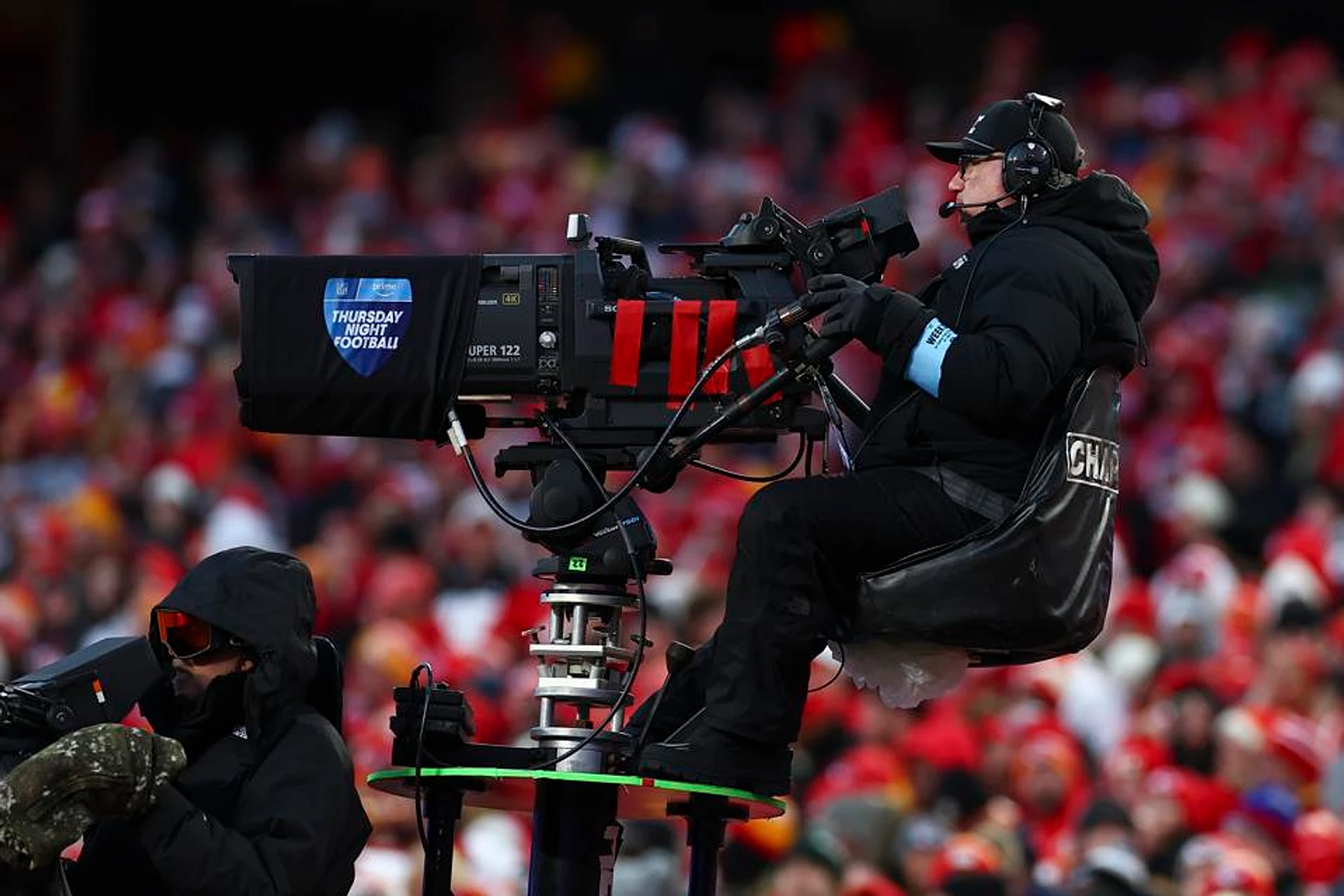


Thursday Night Football on Amazon Prime Video is just one of many streaming services offer NFL games. (Photo by Aaron M. Sprecher/Getty Images)
Since 1961, the Sports Broadcasting Act helped the National Football League turn collective television deals into the foundation of a media empire.
But as games migrate to Amazon, Netflix, YouTube and cable subscriptions, critics argue the law no longer fits a marketplace where fans must pay multiple companies just to watch their teams.
That frustration has reached Washington, where lawmakers from both parties are questioning whether the league’s media model is driving up costs for fans.
GOP Utah Sen. Mike Lee requested a Department of Justice investigation to determine if fans are harmed by the NFL broadcast deals that are costing viewers more than $1,000 a year to access pro football content. On April 15 Wisconsin U.S. Sen. Tammy Baldwin said she will introduce the “For the Fans” Act to decrease consumer TV costs and end out-of-market subscription blackouts.
“The bottom line is it's a fairly narrow exemption today, because it only applies to free, over-the-air broadcasts,” Matthew Mitten, professor and the executive director of the National Sports Law Institute at Marquette University Law School said. “Everything else [is] potentially subject to antitrust challenge by DOJ.”
The 1961 legislation was passed when all televised games were available free with broad public access on broadcast networks. In the modern model, games are also aired across multiple subscription platforms, including Monday Night Football on ESPN, Thursday Night Football on Amazon Prime, Christmas games on Netflix and Sunday Ticket on YouTube.
Football broadcasts are arguably the most popular and profitable viewing options in entertainment, with the 2025 regular season averaging 18.7 million viewers. NFL games accounted for 93 of the top 100 most-watched U.S. TV broadcasts in 2023. In 2025, CBS’s national Sunday broadcasts averaged 25.8 million viewers.
But the league’s rise to dominance has not been without challenge.
In 1953, the NFL was in U.S. District Court for the United States v. National Football League case, which affirmed the legality of blacking out games within a 75-mile radius of a home team's city. It also left individual teams competing against each other to negotiate television deals.
Four years later the Supreme Court decided in Radovich v. National Football League that the NFL was subject to antitrust law and could not coordinate or restrict competition—including broadcasting—without facing antitrust violations.
When the NFL sought to collectively sell teams’ TV rights, it looked like collusion under antitrust law until Congress provided both guardrails and an open lane that avoided antitrust with the Sports Broadcasting Act. The end result: Leagues were guaranteed limited antitrust immunity to collectively sell national TV rights..
The league now licenses games to subscription-based streaming platforms, premium cable networks and technology companies, placing some of its most desirable inventory behind paywalls.
That shift has raised a broader public-policy question: whether watching America’s most popular sport is becoming a paid privilege rather than broadly accessible entertainment. Once playoff and Christmas games started appearing exclusively on streaming services, the problem became too big to ignore, Mitten said.
“They never saw streaming coming when they decided this,” Mitten said. “There was at least one NFL playoff game that was only available only on Amazon Prime, and that’s going to create a lot of… upset fans who don't have that.”
The NFL has defended its approach by saying nearly 90% of its games remain free for local fans. The league invoked a similar argument in the 2024 Sunday Ticket class-action case, saying its DirecTV package was a premium product while local games stayed free on broadcast television.
A jury did not buy the argument, finding the league violated antitrust laws by "pooling" broadcast rights to inflate prices for out-of-market games and awarding $4.7 billion in damages, which could triple to over $14.1 billion under federal antitrust laws.
The verdict was overturned and the case is currently under review by the U.S. Court of Appeals for the Ninth Circuit. A decision is expected later this year.
The Sports Broadcasting Act may protect collective sales of free over-the-air broadcast rights, but newer cable and streaming deals have no such protection and remain open to legal challenge, Mitten said.
Future lawsuits could come from consumers, state attorneys general or federal regulators increasingly willing to challenge anticompetitive behavior. Mitten acknowledged those cases are difficult because courts must weigh whether league cooperation unfairly limits competition or serves legitimate purposes, such as revenue sharing and helping small-market teams remain competitive.