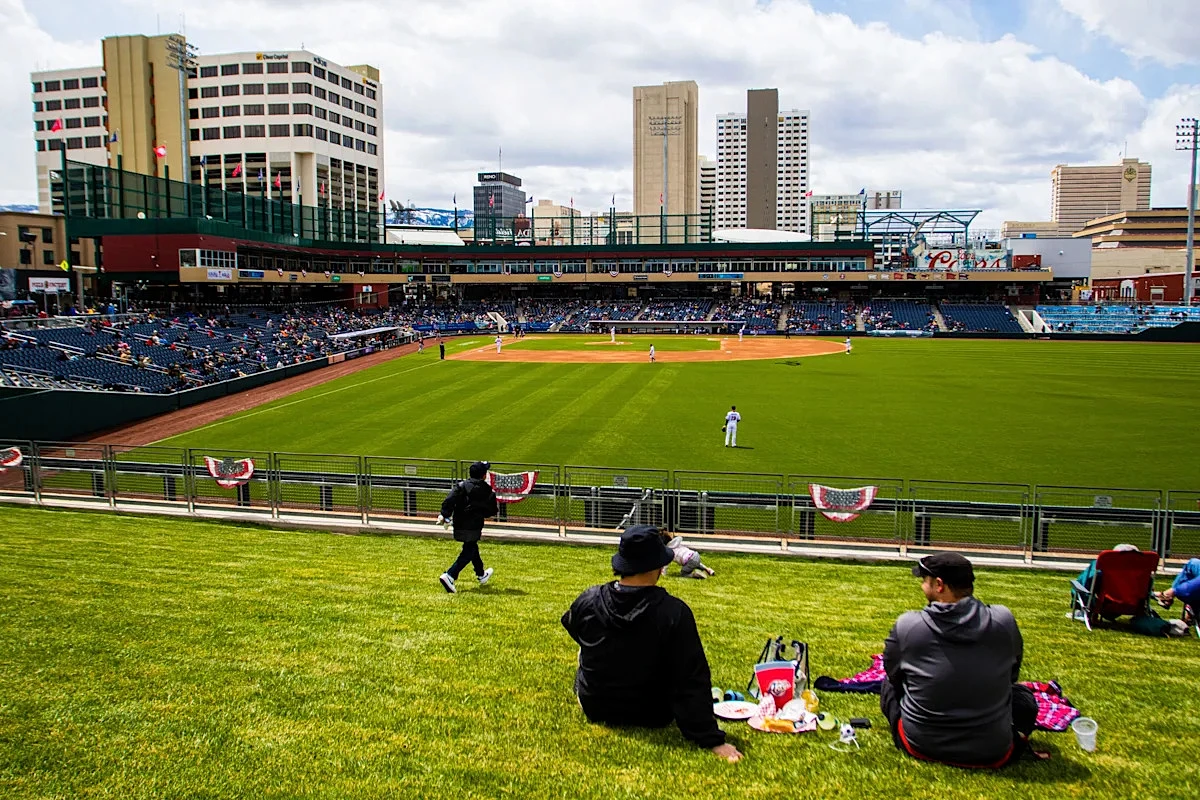


This topic has been one of discussion for almost as long as the Diamondbacks have had an affiliate in Reno. The Aces became Arizona’s Triple-A team in 2009, and in 2012, we dug into the numbers. The methodology we established there has remained constant, so let’s review. What we do is take the stats for every hitter to make at least 50 plate appearances for Reno and 50 for the major-league team. This controls, as best as possible, for player talent and development. For the period in question, we add up all the numbers to give us two big buckets: one in Triple-A, one in the majors. The drop-off is what we should expect to happen on average when a player is promoted to the big leagues.
The first time we checked was in June 2012, covering the period from 2009-2011, and here’s what we found.Reno: .307/.392/.517 = .909 OPSMLB: .226/.296/.374 = .670 OPSIn round numbers, that’s basically a difference of 80/100/140 in BA/OBP/SLG, with a 239-point drop in OPS. We then revisited the situation in 2017, but we had to be cautious. Because in the middle of that period, Aces Ballpark had become just the fourth baseball stadium to store baseball in a humidor – joining their fellow Pacific Coast League teams in Albuquerque and Colorado Springs, as well as the Rockies.
Therefore, it probably make sense to focus on the post-humidor production, and see what impact this had on the numbers. So we repeated the process for 2014-2017, and these were the results:Reno: .304/.365/.476 = .841 OPSMLB: .222/.272/.344 = .616 OPSIt does appear the humidor had the desired effect of reining in Reno offense somewhat, with slugging percentage dropping by 41 points, while batting average was almost unchanged. However, MLB production was also lower. Hard to be sure why: overall, OPS in 2017 was up by 26 points on the 2012 figure. But the bottom line is, the “Reno drop”, while lower, was still very significant: roughly 80/90/130 across the triple slash, with a 225-point decrease in OPS.
Conveniently, after that 2017 season, the Diamondbacks announced they would be installing a humidor at Chase Field, and that went into operation for the 2018 season. What impact would that change in conditions have on the numbers? My instinct is, it would lower power output at the major-league level, and lead to an increase in the OPS split compared to Reno. So let’s see. Once again, I cranked up the spreadsheets and input the numbers for players with at least 50 PA for both the Aces and the Diamondbacks. These are tallied below, both for each individual season and overall. [Reading those names is also quite the nostalgic journey through team history!]
It’s fun to look at some of the individual numbers, though the sample sizes for some are highly suspect. The biggest gap belong to Diamondbacks’ legend Josh Van Meter from 2021. He batted .388 with nine home-runs in just 68 at-bats for Reno, but just .212 with six home-runs in 274 at-bats in the majors. That was a drop-off of 768 points of OPS, from 1.419 down to .651. All told, forty-two players qualified for the study across eight seasons (there was n0 2020 for Reno). Forty of them dropped a hundred OPS points or more. The exceptions? Ildemaro Vargas declined only 43 points last year, and Stone Garrett lost 52 points in 2022.
There is definitely a range, and any individual player can over- or under-perform the average – especially if one or other sample-size is smaller. For it is one of the tenets of sabermetrics, that any player can hit just about anything over 60 at-bats. Looking just at last year is a good example. Seven players qualified. and the drop-off at the player level ranged from Vargas, who managed to hit with an OPS above .700 in both places, all the way up to Jordan Lawlar’s 421 points of OPS. Jorge Barrosa was also above four hundred. Outside of Vargas, their OPS’s all started with an eight or a nine. In the majors? Outside of Vargas, a six was as high as anybody reached.
All told, that gives us a total sample size of over sixteen thousand plate-appearances, with slightly more (9,052) for Reno than Arizona (7,094). Adding them all up, here’s what we have for the period where both parks were employing humidors, from 2018-2025, with 2020 excluded.Reno: .301/.389/.526 = .915 OPSMLB: .229/.296/.359 = .655 OPSWe do see that both figures have rebounded, and are now closer to the first iteration, rather than the second. Batting average is a little closer than last time (a 73-point gap, compared to 82 and 81 points previously), but on-base percentage is almost exactly the same (93 points, vs. 93 and 96). But it’s slugging where the gap has, as expected, grown. There, it’s 167 points now, up from 132 and 143 points previously.
If you want a quick and dirty application, with humidors in effect both at Aces Ballpark and Chase Field, I’d say you mpw need to discount the triple-slash lines of players in Reno, by 70/90/170 points. As an example let’s take a look at the player many are calling for to be brought up, Ryan Waldschmidt. As I write this on Wednesday, his numbers for the Aces are .337/.455/.554, good for an OPS of 1.010. But if we apply the “Reno drop” adjustment, we’d be expecting .267/.365/.384 as his line in the major-leagues. That’s an OPS of .749: not bad, but basically a little below Barrosa’s .763 to date. Waldy will be up when he’s ready.
So expect me to wave this article, every time somebody demands the call-up of a player with an Triple-A OPS any less than a thousand. Of course, the reverse – although I suspect to a smaller extent – is true for pitchers, with Reno ERAs likely to under-estimate their talents. That’s a subject for another day though.