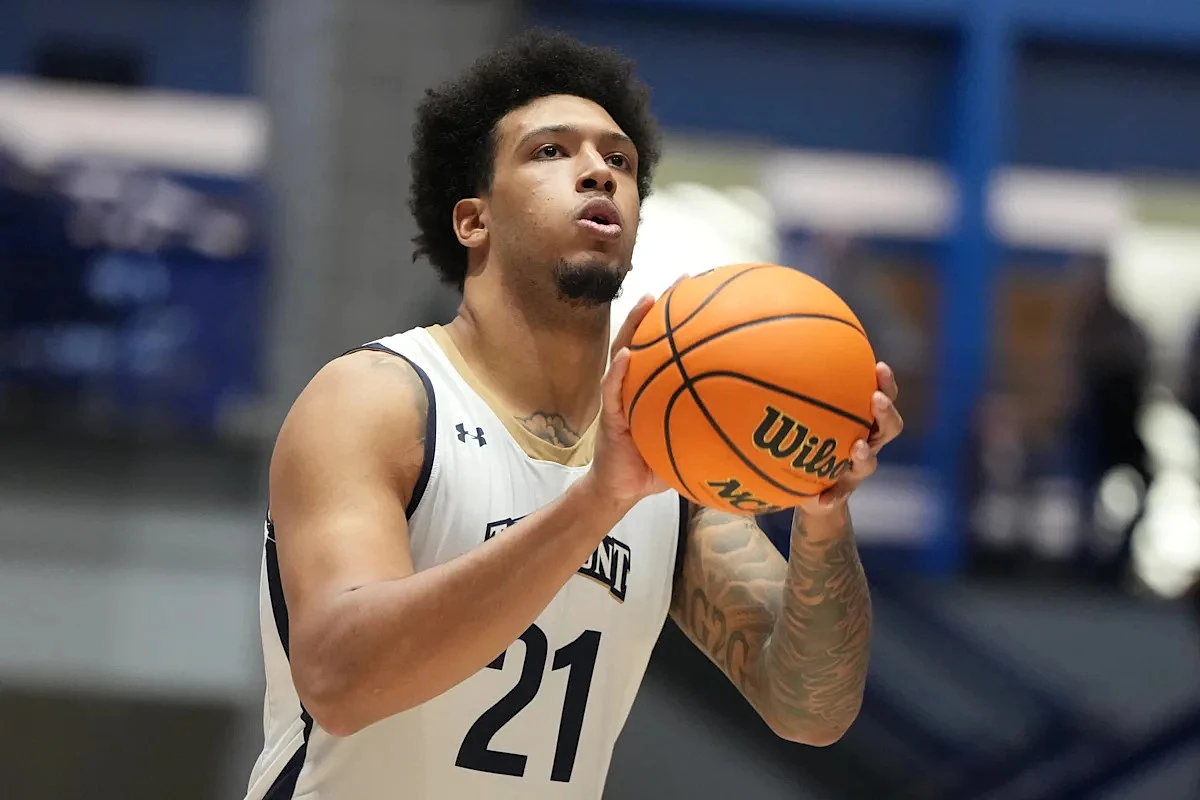


As of this writing, Northwestern has landed four incoming transfers in the portal. The first, Jack Karasinski, I wrote about here. The other three and future adds (Northwestern has just nine players on its roster right now) will be covered in the coming weeks. Today, we’ll take a look at the lone center landed by the Wildcats so far, Luke McEldon.
McEldon transfers in from Mount St. Mary’s where he scored 11.7 points per game and cleared 6.2 rebounds a night. The London native led the Metro Atlantic Athletic Conference (MAAC) in field goal percentage at 64.5%, as well as effective field goal percentage, which he posted the same number for.
There’s a lot to like about the way McEldon plays, but some questions about his role on the offensive end and whether his game comes with the requisite scalability to the Big Ten after barely seeing the floor in two seasons at Santa Clara prior to his junior campaign in Maryland.
All stats sourced from College Basketball Reference and Hoop Explorer unless otherwise noted. All film pulled from Big Ten Plus.
McEldon profiles to have a bigger defensive impact than on offense for Northwestern, so that’s where we’ll start.
McEldon’s defensive profile as a 6-foot-10 center is quite interesting. He is fully ground-bound and not super mobile in coverages, but he is so sturdy that teams struggled scoring at the rim against him. McEldon played about two-thirds of center minutes for The Mount, who posted the 5th best rim defense in the sport and limited opponents to a bottom-30 rate nationally in rim attempts. McEldon was excellently positioned defensively at all times, which should come as a breath of fresh air for Northwestern fans after watching Arrinten Page lose contain at a ridiculous rate. In many ways, McEldon is the anti-Page on the defensive end. He won’t block a ton of shots, he won’t get above the rim for rebounds and he doesn’t have quick hands to get deflections. But McEldon won’t get pulled out of position, never bites on pump fakes and is always in the mix for rebounds.
The Mount played two games against Big Ten teams and I watched them both. McEldon got scored on at the rim about three times across the two games, despite Ohio State packing one of the larger front courts in the Big Ten and Maryland being a rim-heavy attack. He does a bit of everything in the first clip. You can see him monitoring the middle of the floor, barking out instructions and assurances for the guards defending the perimeter. He comes over to help on a baseline drive and recovers to force a miss from his man despite not leaving his feet. The rest of the clips are more or less the same. Someone tries to take McEldon off the bounce, only to find that he’s impossible to go through (he was listed at 240 pounds last year and is probably closer to 250) and tough to go over.
The Mountaineers used him mostly in a deep drop coverage in these two games, choosing to limit the amount he has to move on the perimeter by not hedging or switching. Northwestern has shown the ability to change their defensive coverages depending on their personnel and their opponents’ scheme, although Chris Collins and Chris Lowery still prefer a hard hedge. However, Nicholson wasn’t particularly mobile and was still very successful centering a hard hedge defense, so don’t rule it out. The Mountaineers also used the ultra-rare 3-2 zone on occasion, but similar to Karasinski, his defense in those situations doesn’t matter for evaluative purposes because Collins plays zone approximately never.
Defensively, the main concerns come against having to deal with bigger, more athletic centers in the Big Ten. He was one of the largest guys in his conference, and there’s no real threatening athleticism in the MAAC, so he wasn’t dinged at all by his lack of upward mobility or foot speed. McEldon held up solidly on the defensive end against guys like Christoph Tilly, but having to go against guys of his caliber or better every night may drum up some flaws in his defensive game.
The rebounding is where McEldon made his biggest mark at Mount St. Mary’s and a much needed jolt of life for a Northwestern team that was the worst defensive rebounding team in the Big Ten and not much better on the offensive side. Only one clip here, but it’s illustrative of his strengths on the glass. McEldon won’t jump out of the gym to grab the ball, but he’s physical, has long arms to get taps and has good double jump ability. He’s also very fundamental blocking out and positioning himself for a rebound without fouling. McEldon had an offensive rebound rate of 8.3, meaning he grabbed about 1 of every 12 missed shots by his team, and a defensive rebound rate north of 18. Both marks rank amongst the elite in the country and while the rebounding numbers will decrease in the Big Ten (he was the most physical center in the MAAC), his numbers weren’t due to a huge athleticism advantage over opponents, so there’s no reason the glass work wouldn’t scale up.
McEldon’s offense is secondary, but there’s plenty of intriguing elements that could make him more than just a defense-only player. He was in the 93rd percentile in post-up frequency at The Mount, something that Northwestern doesn’t do often with their centers. Even Page, who had a much bigger offensive role than Nicholson before him, had a post-up rate in the 53rd percentile. McEldon was in the 67th percentile in efficiency in post-up situations, scoring 0.89 points per possession. He doesn’t demand the ball, but he does a good job of finding mismatches in the post and getting into backdowns early in possessions, especially out of transition opportunities. While he won’t have nearly the same post-up frequency in Evanston, there’s reason to believe he can get back to the basket buckets in the flow of the offense.
McEldon doesn’t have a go-to move in the post, but he can finish with both hands and put the ball on the deck to get to his spot. I did watch him miss a couple of easy ones, but he has soft touch which can stretch out fifteen feet into a push shot in the right situation. He can also create for himself, although his lack of a jumper means defenses can trust that he has to go all the way to the rim. Even still, he can get to the rim from the perimeter when he needs to and score on the move when he does.
The other thing McEldon does well offensively is pass, especially from the post. McEldon was double teamed more than any other player in the MAAC last season, so he had to give the ball up to open shooters a lot. I don’t foresee him making the same difficulty of passes that Page did, but he’s capable of finding an open shooter on the other side of the court and can beat a defense with a pass from any spot on the floor. Adept passing bigs have been a theme for Collins in recent years, as he loves to use his five man as an offensive hub. McEldon fits a lot like Nicholson in this usage. He won’t shoot from outside, but Mount St. Mary’s used McEldon a lot in dribble handoffs and zoom actions where he could create space for a perimeter player with his defender sagging off. He can also find a cutter, meaning NU can run off-ball actions with four shooters to create an open look, which was common with Nicholson.
McEldon shouldn’t get played off the floor because of his offense, but don’t expect it to shine at the Big Ten level. He will struggle to back down stronger power conference centers, and he has a concerning turnover rate that may climb even further at Northwestern.
Like Karasinski in my last breakdown, I think McEldon works better as a role player off the bench than a starter. However, in the week since Karasinski and McEldon signed, there haven’t been enough signings to make me think either will be anything but starters and major contributors. While I have significant doubts about the outlook of the team if Karasinski and McEldon both start, the fact of the matter is that there aren’t a lot of reasons for optimism with the rest of the roster slots for Northwestern.
In terms of what Wildcats fans can expect, a good outcome would be 75% of Matt Nicholson. Their scoring profiles are different, with Nicholson being more of a rim-runner in PnR and McEldon being a post-up first player, but they have similar passing traits and the defense projects similarly. If McEldon reaches Nicholson’s level of his final two years that would be a huge success, but a more realistic outlook is someone more like Blake Preston, who had serious success at a mid-major, but struggled to have the same impact after making the jump. Preston is one of McEldon’s player comparisons on Hoop Explorer and I imagine that is closer to where he ends up, although maybe thrust into a much bigger role due to lack of better available options.