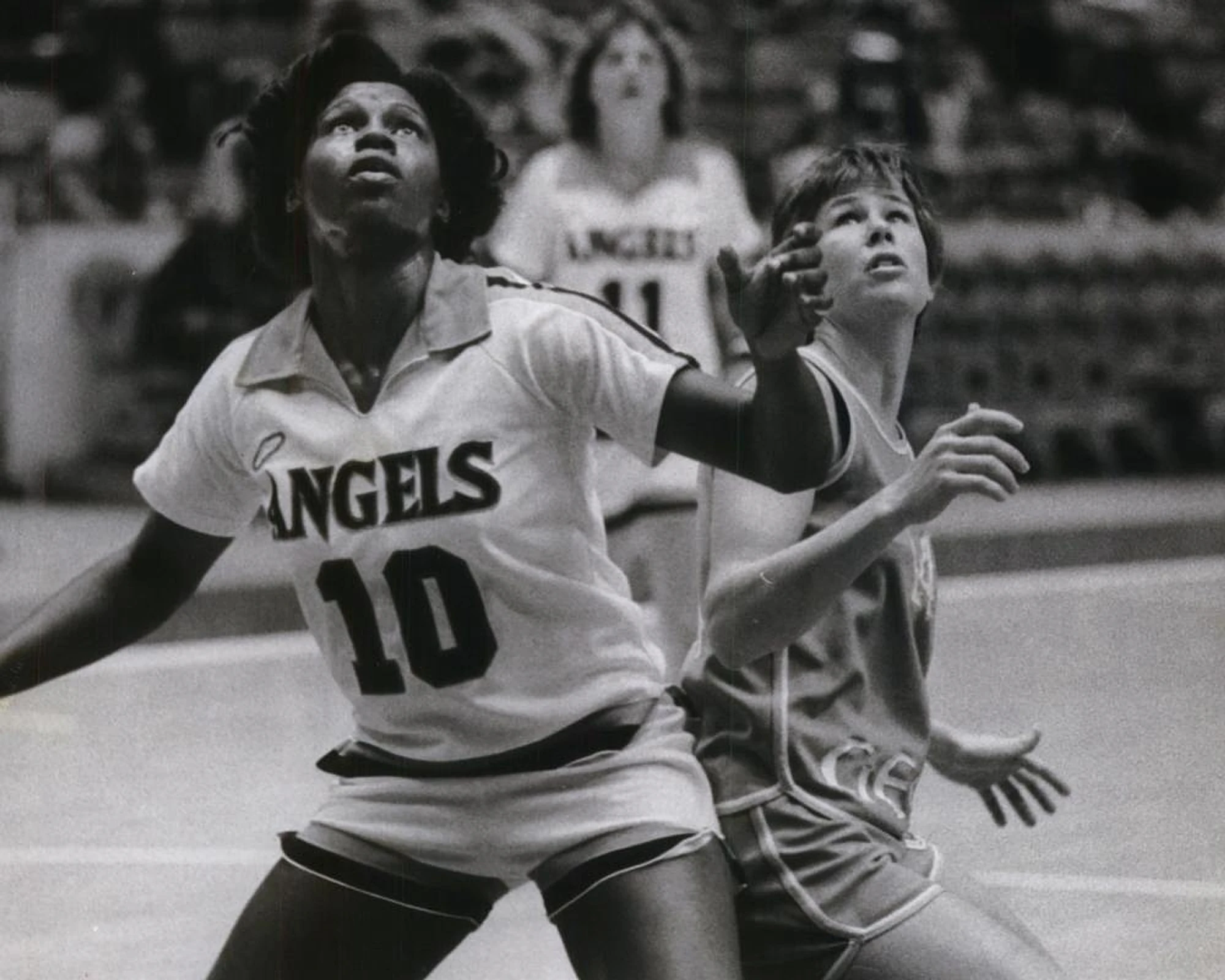

It was the night before the 1980 Women’s Professional Basketball League draft in New York City and the Dallas Diamonds had the No 1 pick. But the team’s top brass was split. Coach Greg Williams wanted to take the 6ft 5in Danish star Inge Nissen, and the team’s GM Nancy Nichols prized Nancy Lieberman, the American point guard people called “Lady Magic”.
“We argued for days about Nissen versus Lieberman,” Nichols tells the Guardian.
Nichols remembers the hours after dinner that night; everyone had retired to their rooms. But hers was just one floor above Williams’s. In a last-ditch effort to convince the Diamonds coach, she put Lieberman’s name on a piece of a paper and, using coat hangers, dangled it down from her window to his. With her free hand, she called his room, “Hey, Greg,” she said. “Look out your window and see if there are any signs from above!”
Related: Gossip around Azzi Fudd and Paige Bueckers’s relationship misreads the WNBA
The next morning, the Diamonds’ team owner Mike Staver was late to the draft. The Diamonds’ staff looked around – who should we take? But just a few minutes before the pick was due, Staver walked in to make the selection. “I think he’d been drinking all night,” Nichols says, with a laugh. “Mike walked up and said, ‘The Dallas Diamonds are proud to draft … Nancy Lieberman.’ I just put my head down and was like: ‘Oh my gosh!”
That season, Lieberman, who had won two college championships at Old Dominion in the years prior, entered the WBL, where she won Rookie of the Year. Score one for Nichols.
Sadly, though, the WBL folded after that 1980-81 season – its last game was played 45 years ago, on 20 April 1981. The league had lasted just three wild, groundbreaking years but it laid down a marker as the first-ever women’s professional basketball league in the United States. What began in 1978 lasted through 1981, and while few hoops heads remember the WBL now, the league boasted 17 future Hall of Famers and nine Olympians among its ranks, including Lieberman and Ann Meyers.
But being the first in any field is hard. Nichols remembers games when the Diamonds drew 700 people “on a good night,” though she also recalls the growing interest in Dallas, with the team attracting crowds of up to 3,500 in their third season.
The WBL, which was founded by Bill Byrne, began with eight squads in cities such as Chicago, Houston, and Des Moines. Similar to the ABA a decade prior, teams came and went each season. “We knew the league was really struggling,” Nichols says. “I talked to other people on other teams. It probably expanded too much. I could make a million excuses.”
Still, despite its short-lived tenure, the WBL was important. Out of thin air, it created a new place for women to play professional basketball. “I can’t describe what it’s like to be a pro without a league,” three-time WBL All-Star Molly (Bolin) Kazmer tells the Guardian.
Kazmer, who played for the WBL’s Iowa Cornets, also holds the distinction of being the first player ever signed by the league. She inked a deal with the Cornets on 30 June 1978, in the Iowa governor’s office. By then, she was known as a standout player in Iowa, having shown a scoring prowess as early as her sophomore year in her small home town of Moravia.
“I had 12 girls in my class and only three of them played sports,” Kazmer says. But where there’s a will, there’s a way. Growing up, she played against older girls. She worked so hard that on her 16th birthday, Kazmer dropped 63 points in a high school game before heading to Grand View University in Des Moines to play college basketball. “That’s who I was as a player,” she says.
A shooting guard, Kazmer played all three years of the WBL’s existence, setting scoring records, notching 50-plus points a number of times. In her second year, she averaged 32.8 points a game, earning co-MVP along with Meyers. Her Cornets team played in the first two WBL finals, losing both.
Their success was the result, in part, of the state’s progressive policies towards women’s sports. In 1925, Iowa formed the Iowa Girls High School Athletic Union, decades before Title IX advancements. The ripple effects continue through today, most notably in the form of Des Moines native Caitlin Clark.
WBL seasons spanned November to April and teams traveled coast-to-coast. Kazmer remembers the bus that Cornets owner George Nissen built, which included plush seats, full carpet and TVs. By the third season, the league enjoyed an influx of players who had been holding on to their “amateur” status ahead of the 1980 Olympics (unfortunately for them, the US boycotted the Games). But by then, it was too late. The league couldn’t last. In the WBL’s final ever game, the Nebraska Wranglers defeated the Diamonds 3-2 to win the 1981 championship.
Still, there are plenty of memories. Kazmer recalls one occasion when the team’s plane, just after taking off in New York City, had to make an emergency water landing due to problems with the landing gear. She remembers another time in Houston when there was a “biblical flood” prior to Game 2 of the WBL finals.
“We were wading around in a parking lot waist-deep in water,” she says. “But it was such a fun time. We knew that we were pioneers, that we were the first, that we were making it happen. We took that responsibility very seriously.”
Nichols most values the camaraderie. How people banded together despite the odds.
“Living in a man’s world, playing in a Dallas Cowboys town,” she says, “I cannot tell you what a barrier that was, especially because by then they were America’s Team. But they were all very supportive of us.”
For the Diamonds’ first-ever home game, Nichols asked her friend, Martina Navratilova to toss up the ceremonial jump ball. Not only did the tennis star do it, but Cowboys players had courtside seats for the game.