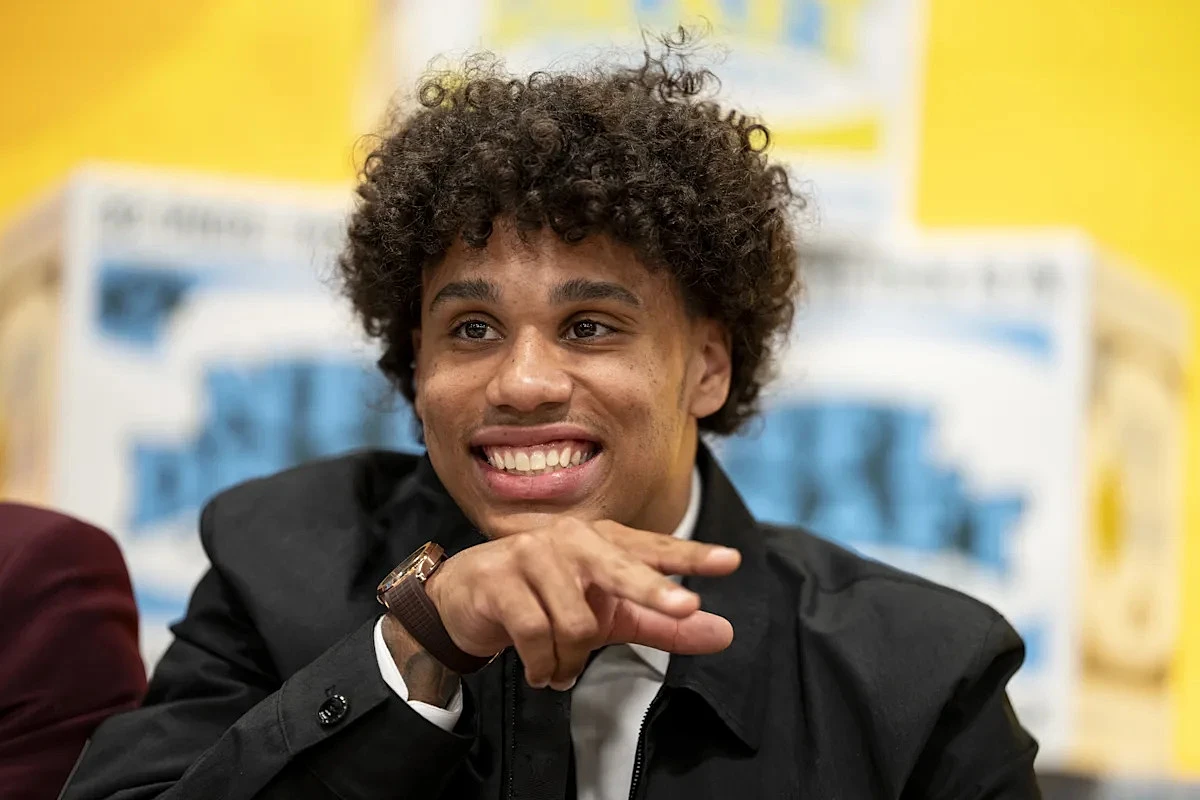


Now that the dust has settled and we’ve had some time to evaluate the entire process, I think the New Orleans Saints did a great job in the draft and had a clear vision with a patient approach. They never got aggressive or attempted to move up. If anything, they played the board and used what they had to add more players than their original number of picks.
Overall, I give the Saints a B+ in this year’s draft but let’s also look at each individual players as well.
Let’s start with the first selection in this class. Jordyn Tyson, selected at No. 8 in the first round, earns a B grade. If Tyson did not have injury issues, he likely would have been drafted higher than eighth overall. He is the most talented wide receiver in this class, hands down. If healthy, he will eventually become the true primary target in this Saints offense. There is one ability that Tyson possesses that does not get talked about enough: he is a willing blocker in the run game. Not only is he willing, but he also desires to block. This means he will consistently stay on the field, making it more difficult for defenses to determine whether the Saints are running or passing based on their personnel packages.
Christen Miller was the next selection, taken at No. 42 overall in the second round. This was a great pick and earns a B+ grade. There is an immediate need for a true nose tackle on this team. While the Saints have plenty of defensive tackles, only a couple can actually line up over the center and effectively collapse the line of scrimmage and stop the run. This allows the interior linebackers to flow freely, fill gaps properly, and help fix the rushing defense issues the Saints have been dealing with recently.
Oscar Delp followed at No. 73 overall in the third round. This was probably the biggest steal in the draft. Delp is viewed as a prospect who was never given the opportunity to fully showcase his potential at the University of Georgia. He was believed to be the heir apparent to Brock Bowers, but his offensive coordinator, Todd Monken (now head coach of the Cleveland Browns), left after Delp’s freshman season. That same year was also Bowers’ final season at Georgia. The change in offensive philosophy affected Delp to the point that he never had a season with more than 25 receptions in three years, even though he averaged over 11 yards per catch. Delp has the potential to become the best tight end in this class, and the Saints were able to get him in the third round. He can line up inline and block, split out wide, run routes, and make contested catches. This selection earns an A.
At pick No. 132 in the fourth round, the Saints selected Jeremiah Wright, an offensive guard from Auburn. This is a solid pick that earns a C+ grade. It fills a need for offensive line depth while also providing a player who could develop into a starting guard during his rookie contract. Wright is strong at the point of attack, has a violent punch, and plays with a strong base. He is a road grader in the run game—he moves people. However, he is susceptible to speed moves on the interior and needs to improve his lateral quickness, footwork, and pad level. Still, his attitude is perfect for an interior offensive lineman.
Also in the fourth round, at pick No. 136, the Saints selected Bryce Lance from North Dakota State. Lance has elite size and speed. He stands at 6’3”, 204 lbs., with 9.25-inch hands, and ran a 4.34 40-yard dash. He averaged 21.2 yards per reception on 51 catches, finishing with 1,079 receiving yards and 8 touchdowns. He was an AP FCS All-American. This is a wide receiver who can take the top off a defense. This selection earns an A-
In the fifth round, at pick No. 172, the Saints selected Lorenzo Styles Jr., who earns a B. Styles Jr. is the older brother of Sonny Styles. The interesting thing about him is that he converted to defensive back after playing wide receiver at Notre Dame. He is very athletic and still has a lot of raw potential at the position. He ran a 4.27 40-yard dash.
In the sixth round, at pick No. 190, the Saints made LSU fans and the city of Baton Rouge smile by selecting Barion Brown. Brown is another burner at wide receiver, but he also adds value as a returner on special teams. He tied the FBS record with six return touchdowns in his collegiate career. Adding this weapon on special teams, especially after trading Shaheed to the Seahawks, fills an immediate need and brings explosiveness and swagger to the third phase of the game. This pick earns a B+
In the final round, at pick No. 219, the Saints selected TJ Hall, who earns a C-. Hall is a developmental cornerback. He played primarily zone coverage at Iowa and spent most of his time in the slot. He could develop into a consistent nickel corner or become a valuable special teams contributor.
Overall, Mickey Loomis and his staff deserve a lot of credit for this draft and their approach. They used one of their fifth-round picks to trade for veteran edge rusher Tyree Wilson, a former top ten pick in the 2023 draft. He enters the final year of his rookie deal after not fully living up to that status. This could be an opportunity for the Saints to replicate what they did with a player like Chase Young. Not only did they acquire Wilson, but they also received the seventh-round pick that became TJ Hall. This was a fantastic job of building around Tyler Shough and giving the offense the ability to be multiple while utilizing a strong group of weapons. The defense still has two key questions: what do you do at the star/nickel position, and what do you have at edge? The front office seems comfortable with their options at star, but with the eventual departure of Cam Jordan looming, the edge room remains an area that will need to be addressed, or it could become a major concern heading into next offseason.