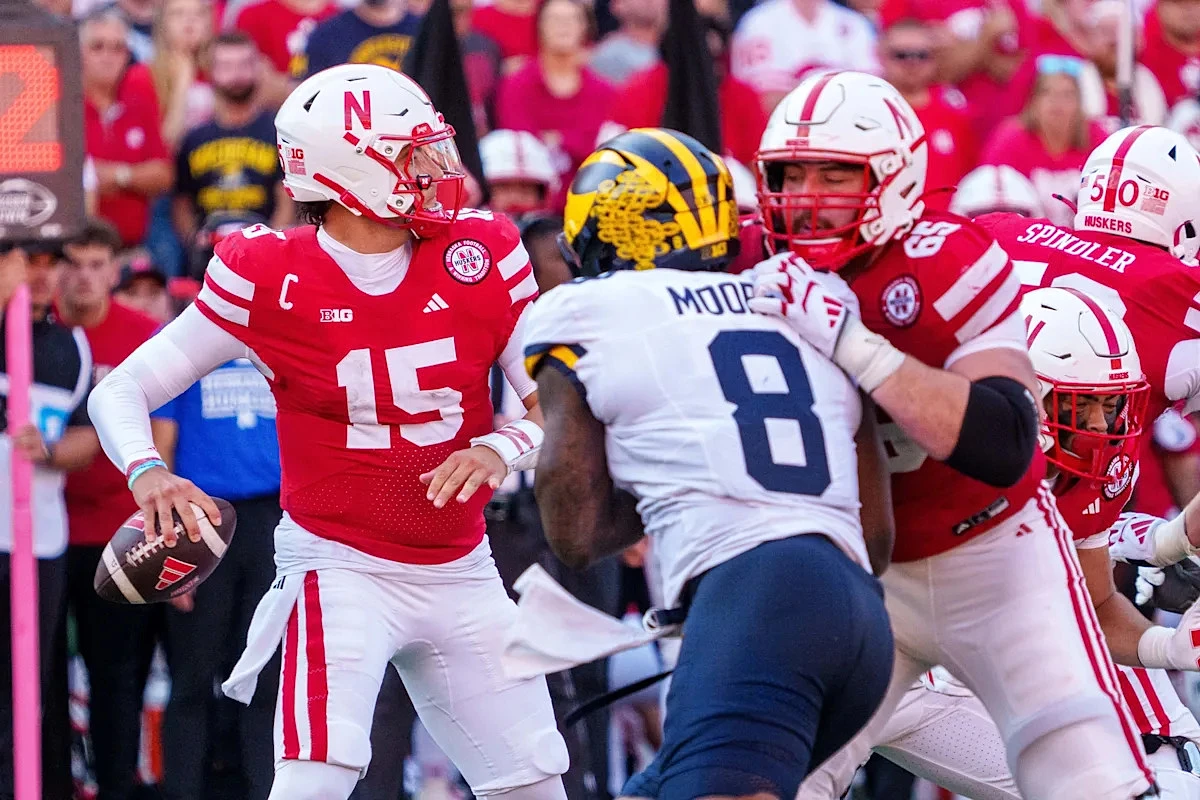


As Detroit Lions general manager Brad Holmes is wont to do, he made a Day 2 trade up to ensure they got the player they wanted. Holmes sent a fourth-round pick (128) to move from Pick 50 to Pick 44 in order to select Michigan edge defender Derrick Moore in the second round.
When asked why he moved up for Moore, Holmes noted that he believed the Baltimore Ravens—who held pick 45—were in the market for an edge defender, and Detroit wanted to get the player they had ranked No. 1 among the available defensive ends to start Day 2.
“I will say he was part of that cluster of guys that we were targeting today. He was already at top of mind going up,” Holmes said. “Just kind of paying attention to who was in front of us, who was behind us. It felt like, just right in that area, there were multiple edge rushers that were flying off. Again, that’s the fascination of the draft–you don’t know. Derrick might have been our No. 3 or No. 4 edge rusher, whatever it is, but today, he was our No. 1 for what was available. For other teams, he could have been their No. 7 or No. 8. You can’t worry about that, you’ve just got to get the guy that you want.”
But did the Lions get good value for that trade up? Did they overpay? Let’s break down the trade based on several draft trade value sheets out there. As a reminder, here were the full terms:
Though most view the Jimmy Johnson trade chart as outdated—it was created in the early 1990s—it does paint a favorable view for Detroit, who comes out with a 16 point advantage—worth the equivalent of a sixth-round pick.
On the more modern draft trade chart, this trade came out exactly even. That seems appropriate given Dan Campbell and Aaron Glenn’s relationship.
This trade chart is more representative of annual salaries of players taken at each position, while the Rich Hill chart is more reflective of the history of actual trades made. In this instance, the Lions heavily overpaid to get Moore. The difference of 477 points is the equivalent of a late Round 5 pick.
So, overall, based on the history of trades in the NFL Draft, this one was right in line with how teams actually value each pick. The Fitzgerald-Spielberger chart, however, suggests that the Lions didn’t value their picks as much as they should. Although I’m sure Holmes is not losing any sleep dropping a fifth-round pick equivalence in value. That is especially true in this year’s draft class, where Holmes showed absolutely no interest in trading back into the third round and essentially called it a day after Round 2.