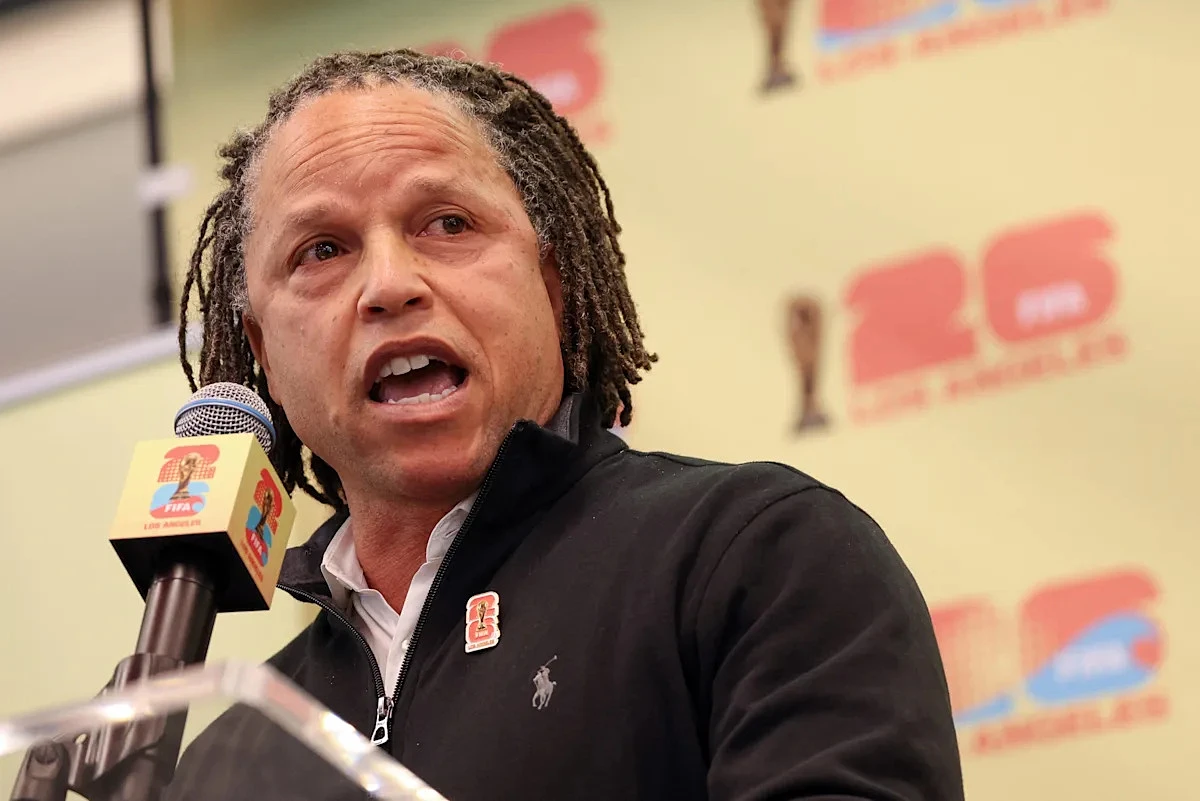


Cobi Jones didn’t feel like an icon. He could barely believe he was a professional.
Black kids from Southern California didn’t become professional soccer players, especially not when they had to walk on at UCLA and picked soccer as their sport when few Americans were playing abroad and a domestic league didn’t exist.
Jones did it, utilizing effort and athleticism to paper over the areas where others may have had more technical ability or traditional coaching. That became his daily life: Make it on the field. Continue to make a living. That was all he could think about.
After his playing career ended with Jones as the all-time leader in caps for the U.S. men’s national team, though, he finally had time to reflect. Continuing to hear from young players who grew up idolizing him, Jones started to have context for what his career meant to others.
“When you’re playing you’re just like, ‘Woo hoo!’ I’m playing professionally! I’m making money!” Jones told USA TODAY Sports. “As you get older, you start to realize you’re having an impact … and that you’re not just impacting people in soccer but a variety of different ways.
“For myself, people of color seeing someone who looks like them, for the African-American community, it’s a continued processes of understanding how important that has been for so many different people over the years.”
Jones’ contributions will be honored in one of the most permanent ways possible Sunday, as the LA Galaxy unveil a statue of their all-time leader in games played, a player who helped cement their place in Southern California’s culture with his exploits on the field and what he represents off it.
He will take his place alongside statues of other Galaxy legends David Beckham and Landon Donovan in a ceremony before Sunday’s match against Real Salt Lake.
It is part of the Galaxy’s efforts to highlight their history that dates back ‘Since ’96’ - an effort that not so subtly coincides with the arrival and boom in popularity of downtown-based LAFC. But it also raises questions about how the American soccer community thinks about its past, honors its greats and elevates the stories of players who helped build the culture that will be on display as the U.S. hosts the FIFA World Cup this summer.
“Legacy is built over time. People start to recognize. I start realizing legacy is something more when I hear people that watch their kids tell kids about me. That knocks me to the floor. When an eight-year-old comes up to me and says, ‘You’re Cobi Jones! I’ve watched you!’" he recalls. "And I’m like, 'How?' They Googled,” Jones said. “It tells me it has meant something.
“Now, if we talk about the recognition factor, we’re a different country than England or Italy. It’s a different sport than American football or basketball, but we’re building and establishing those legacies, those traditions, those histories year after year.”
Jones currently is working as an ambassador for the Los Angeles World Cup host committee but also does media work, where he’s part of a boom of past national team players regularly commenting on the current squad.
That is de rigueur in England, where Jones played with Coventry City, in Brazil where he signed with Vasco de Gama after turning heads during the 1995 Copa América, and other countries around the world. But it’s still a relatively new phenomenon in the American soccer world where veterans often haven’t had enough name recognition for broadcasters to hire them to opine.
He is honest in his critiques but also understands that his experience may be less relevant to current players than that of some of his media colleagues. Jones’ first pro contract was signed with the U.S. Soccer Federation itself, which brought players together as a type of club team leading into the 1994 World Cup in hopes the team would have a good showing in its first home World Cup.
It might have worked. The U.S. got out of the group and fell to eventual champion Brazil 1-0 in the round of 16. But Jones noted “you will never see anything like again” because of the growth of the sport in the U.S. and the business realities of the global game. Only after the home World Cup ended did Jones, well into his mid-20s, sign his first pro contract abroad. The 2002 World Cup, which saw Jones come in to help close out a 2-0 round of 16 win over Mexico, is the best modern showing at the World Cup.
1 (tie). Clint Dempsey - 57 goals (2004-2017)1 (tie). Landon Donovan - 57 goals (2000-2014)3. Jozy Altidore - 42 goals (2007-2019)4. Eric Wynalda - 34 goals (1990-2000)5. Christian Pulisic - 32 (2016-present; through Nov. 18, 2024)
1 / 11USMNT all-time leading goal scorers1 (tie). Clint Dempsey - 57 goals (2004-2017)1 / 11USMNT all-time leading goal scorers1 (tie). Clint Dempsey - 57 goals (2004-2017)2 / 11USMNT all-time leading goal scorers1 (tie). Landon Donovan - 57 goals (2000-2014)3 / 11USMNT all-time leading goal scorers3. Jozy Altidore - 42 goals (2007-2019)4 / 11USMNT all-time leading goal scorers4. Eric Wynalda - 34 goals (1990-2000)5 / 11USMNT all-time leading goal scorers5. Christian Pulisic - 32 (2016-present; through Nov. 18, 2024)
Rather than being a cranky old man with a microphone wondering why the current squad isn’t getting as far as the team did back in his day, Jones hopes to become known as a mentor figure. Whether a young Black kid trying to find his way in soccer or a retiring pro who represented the national team, Jones has served as a sounding board for athletes navigating what comes next.
“t’s putting myself out there and making sure people know I’m open to help,” Jones said. “People will say I’m a pioneer within soccer. I’d say that, because of that, I’m a pioneer in other ways. I’m one of the first in my generation playing soccer professionally that supported you and then what do you do after that’s done? That’s something we’re just starting to get into within in the U.S.”
He also wants young players to understand something he didn’t when he played, that every decision, every moment of their career — and the decisions they make in their private life — are the building blocks of their careers.