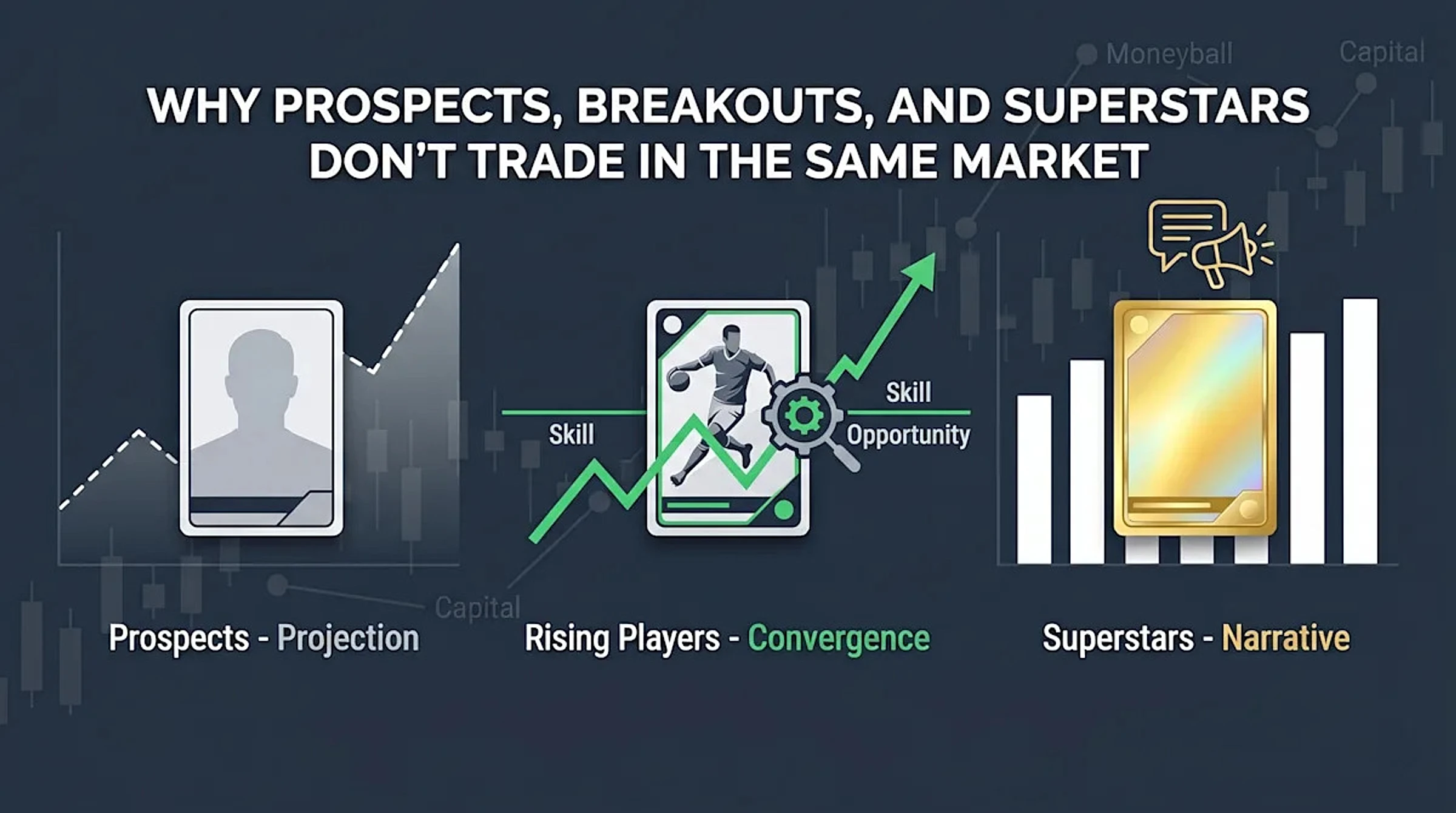
In the world of sports card collecting, understanding the market isn't just about spotting the next big star—it's about recognizing that not all players are created equal when it comes to value. The market operates in three distinct tiers, each with its own rules, risks, and rewards.
Think of it as a three-layer system: prospects, breakout players, and established superstars. Each responds differently to skill, opportunity, and narrative—the three forces that ultimately drive prices. Skill develops first, opportunity follows, and narrative forms last. Prices only move when all three align.
The common mistake? Treating every player the same. It's tempting to channel your inner Billy Beane and hunt for undervalued talent before the market catches on. But in card collecting, that approach only works if you understand which market you're playing in.
The Prospect Market: Betting on Potential
At the earliest stage, you're buying potential, not production. Players like Konnor Griffin and Kevin McGonigle are valued for their tools—bat speed, contact profiles, physical projection—not their proven results. For pitchers like Chase Burns, the equation gets even trickier: velocity and strikeout stuff must eventually translate to command and consistency. International prospects like Jesús Made and Hyeseong Kim add another layer of complexity, where performance must cross leagues and cultures.
Here, the market fills in missing information with belief. You're paying for narrative as if it were confirmed performance. Projection drives price, but projection is fragile. Most prospects never convert that promise into sustained success, making this the highest-risk tier in the market.
The Breakout Market: Timing the Transition
When a player starts producing, opportunity expands, and the narrative shifts. This is where savvy collectors can find their edge—if they can separate real breakouts from flash-in-the-pan performances. The key? Understanding which skills are sustainable and which opportunities are real.
The Superstar Market: Narrative Cycles and Liquidity
At the top, superstars trade on narrative cycles and market liquidity. Their value is more stable but moves differently—driven by championships, MVP seasons, and cultural moments rather than raw potential. This is where big capital plays, and where understanding the emotional cycles of the market becomes as important as the stats.
The same player can move through all three stages—but most never do. The real edge isn't just knowing the framework; it's knowing which version of the framework you're operating in at any given moment. Whether you're hunting prospects, timing breakouts, or investing in superstars, the rules change. Play accordingly.