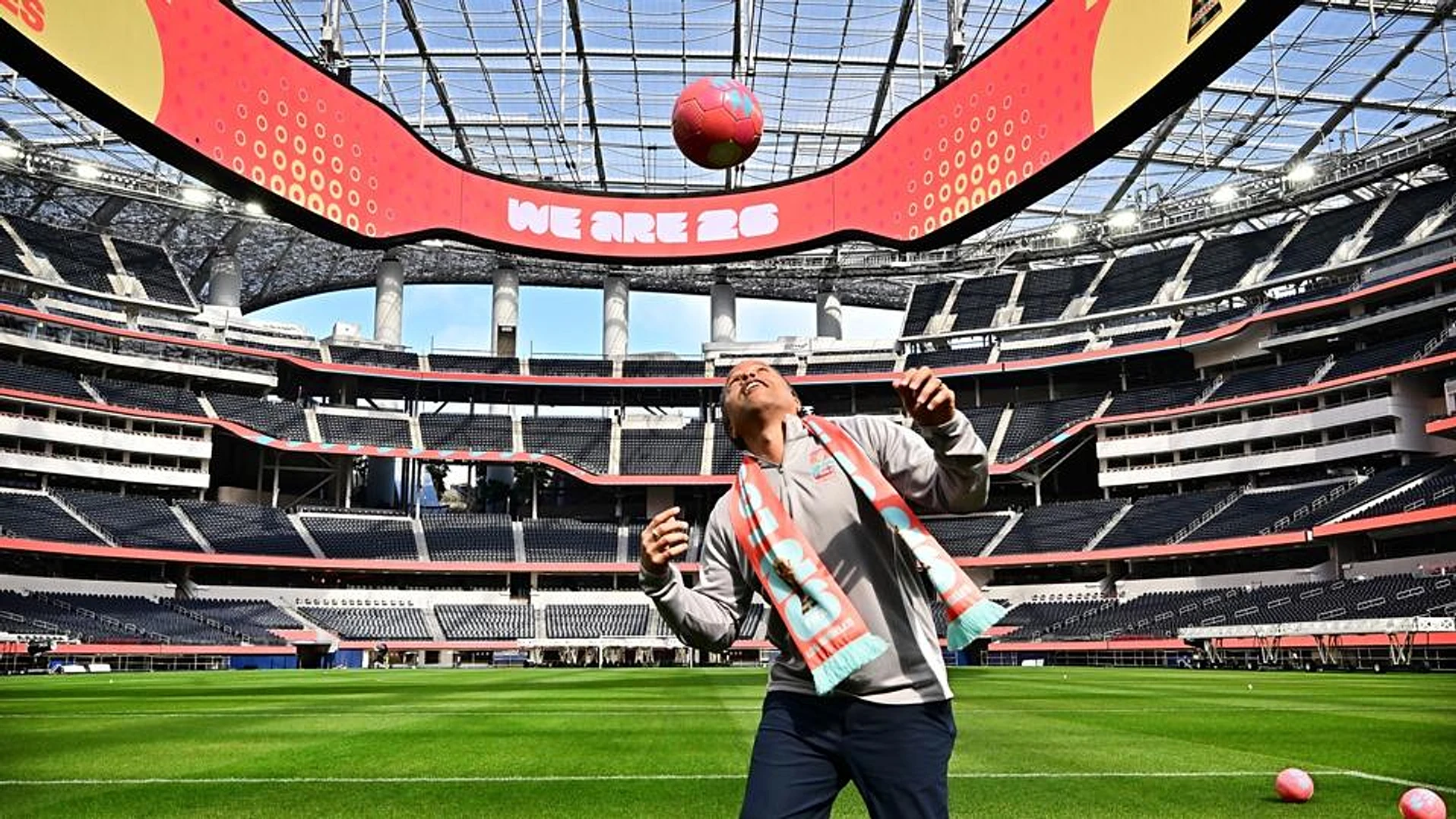


Former US national team player Cobi Jones juggles a ball on the new test pitch for the 2026 FIFA World Cup at Sofi Stadium in Inglewood, California, on March 13, 2025. The pitch will be used for the upcoming Concacaf Nations League semifinals on March 20 when the US play Panama and Canada plays Mexico. (Photo by Frederic J. BROWN / AFP) (Photo by FREDERIC J. BROWN/AFP via Getty Images)
While FIFA has been criticized in some circles for exploitative pricing of 2026 World Cup tickets, in most cases, ticket demand appears to be validating their approach, at least from an economic standpoint.
One exception, a report Tuesday from The Athletic suggests, is the United States men’s national team’s two group games in Los Angeles.
The report estimates that a bit over 2,000 tickets are still currently available for fixture against Paraguay, billed as special occasion to mark the opening of the majority portion of the tournament to be played on Ameican soil. And that may not include other tickets that FIFA has yet to release, since it continues to make some available at all matches on a rolling basis.
Tickets for the third group game in Los Angeles against Turkey may also be slower than other fixtures, the report adds.
FIFA has pushed back, saying that the documents used to draw this conclusion are misleading. Here’s the relevant paragraph on the FIFA perspective:
A FIFA spokesperson, responding after publication Tuesday, said in an emailed statement that “ticket sales for the FIFA World Cup remain strong with a high degree of interest for all matches, including the ones you have highlighted.” The spokesperson argued that the document “does not accurately reflect actual sales to date” (The Athletic’s report cites ticket data as of April 10), and said “it would be misleading and irresponsible to publish such figures as fact,” but did not say why or how the numbers were inaccurate reflections or misleading.
However, if The Athletic’s reporting does reflect an accurate assessment of demand for USMNT games staged in Los Angeles, it would not necessarily be surprising to those who follow American soccer closely.
Here are five reasons the Yanks might be struggling to lure ticket buyers for two of the biggest matches in American soccer history.
This is Captain Obvious territory. But as The Athletic notes, prices for the June 12 match at the 70,000-capacity venue were the third-highest of all tournament games (behind the final and one semifinal) when ticket sales launched in September.
While the prices of other matches have climbed under FIFA’s variable pricing model, the cost for the June 12 USMNT opener remains at $2,730 for Category 1 tickets, $1,940 for Category 2 and $1,120 for Category 3. (General public ticket applications for all World Cup matches are split into three price categories.)
That’s in line with face value for “lower end” Super Bowl tickets (although secondary market prices typically exceed $5,000 for America’s biggest annual sporting event.) And given the fact that the United States will play twice in the same market in the space of two weeks, and that the real tournament opener will come the day before in Mexico City, it’s understandable that fans might not be convinced to make a Super Bowl-sized investment.
The United States Soccer Federation is not tasked with pricing the USMNT’s games at the World Cup. But it has also come under criticism in recent years for making USMNT games less accessible while the product on the field hasn’t improved.
The average cost of watching the United States play in person nearly quadrupled between the 2002 and 2018 World Cup cycles, according to a 2025 story in The Athletic. That was well above the cumulative inflation of just under 40% between 2002 and 2018, according to the Consumer Price Index. And the 2018 cycle ended in the Americans’ failure to reach a World Cup for the first time since 1986.
Fast forward to 2025, and there are signs of a fanbase that is still sour. Four of the 10 home friendlies marketed by U.S. Soccer in 2025 drew under 20,000 fans, and only one crowd exceeded 30,000. Crowds at the Gold Cup – which is priced and marketed by Concacaf – were also own for matches featuring the American team, particularly in group stage games against poor draws like Trinidad and Tobago, and Saudi Arabia.
The news was much better last month, when the Americans played in front of two crowds greater than 60,000 in Atlanta against Belgium and Portugal. But the relationship between fans and the USMNT has been tenuous ever since the failure of 2018, a sentiment that FIFA’s price practices risk enflamming.
INGLEWOOD, CA - JUNE 14: Fans celebrate during 2025 Concacaf Gold Cup Tournament between Mexico and Dominican Republic at SoFi Stadium on June 14, 2025 in Inglewood, California. (Photo by Edwin So/ISI Photos/ISI Photos via Getty Images)
Los Angeles is the nation’s second-largest metropolitan area. But it is not exactly known as a USMNT hotbed.
Given the city’s large Latin American diaspora, the Mexico national team is likely the most popular international side in Los Angeles, and Central American nations like Honduras, El Salvador and Guatemala also have considerable followings. As far as other competitors in the 2026 World Cup, there are also significant Iranian and South Korean fanbases in Southern California. (Iran will also play two matches in Los Angeles.)
That’s one reason U.S. Soccer and Concacaf rarely schedule matches in Southern California where the American team is the main draw, instead opting for Midwestern or Southeastern locales.